
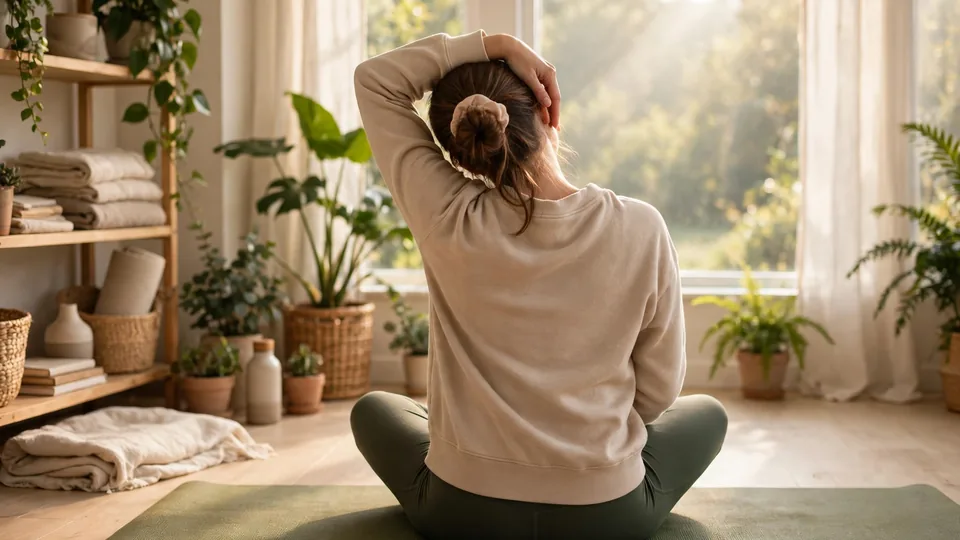
Stiff neck, tight shoulders, a head that turns only halfway before it complains. If that sounds familiar, yoga for neck pain can help, and it does not ask much of you. This guide walks through gentle poses that release tension, rebuild mobility, and strengthen the muscles that hold your head up all day. Each one is slow, simple, and safe to try at home in 2026.
Key Highlights
- Gentle yoga eases most posture-related neck pain by stretching tight muscles and strengthening the deep neck flexors that support your head.
- Slow Hatha, restorative, and Yin styles suit sore necks best. Fast, forceful classes can make the problem worse.
- Eight poses cover the full job, from warm-up stretches and Cat-Cow to Thread the Needle, Eagle Arms, and Supported Fish.
- Stop at sharp pain, numbness, or tingling. Those signals mean see a doctor, not push through.
- Five to ten minutes a day beats one long weekly session. Short, regular practice is what changes posture.
Before You Begin: Safety First
Most neck pain comes from posture, stress, or sleeping badly, and gentle movement helps it. Some neck pain has a different cause, and yoga is the wrong first step for it. Read this list before you practice.
Stop and See a Doctor If You Notice Any of These
- Numbness or tingling in your arms, hands, or fingers
- Weakness in your arms or hands, or dropping things
- Neck pain after a fall, accident, or blow to the head
- Neck pain with fever, unexplained weight loss, or a severe headache
- Pain that shoots down one arm
- Pain that keeps getting worse after a week or two of gentle practice
- Dizziness or loss of balance when you move your neck
If none of these apply, you can start. Keep every movement slow and inside a pain-free range. A mild stretch is the goal. Sharp pain is a stop sign, not a challenge. This guide offers general information only. It is not medical advice, and it cannot diagnose your neck.
How to Practice Without Making Things Worse
Move at half the speed you think you need. Your neck responds to patience, not effort. Hold each pose for five to eight slow breaths and let your breath set the pace. Never pull on your head with your hands. If you use a hand in a stretch, let its weight rest there. Never roll your head backward in a full circle, since that compresses the cervical spine. Practice on a non-slip surface.
Research backs the gentle approach. A 2019 meta-analysis of ten trials with 686 participants found yoga improved neck pain intensity, range of motion, and quality of life. The studies tested slow, controlled practice, not fast or forceful classes, so match your pace to the evidence.
Seated Neck Stretch and Chin Tucks
Start here, in a chair or cross-legged on the floor. Sit tall, drop your shoulders away from your ears, and let your right ear drift toward your right shoulder. Stop at the first mild stretch. Rest your right hand lightly on your head and let its weight add a little length. Never pull. Hold for five slow breaths, return to center, and repeat on the left.
Chin tucks train the deep muscles at the front of your neck, the ones that weaken when your head drifts forward over a screen. Sit tall, draw your chin straight back as if making a double chin, and hold for five seconds. Release and repeat ten times. If you work at a desk, this pair fits into a chair and takes two minutes. Our chair yoga guide shows more seated moves that suit a stiff neck and tight shoulders.
Cat-Cow
Come to hands and knees, wrists under shoulders, knees under hips. On an inhale, let your belly drop, lift your sitting bones, and let your gaze drift forward. On an exhale, press the floor away, round your spine, and let your head hang heavy. Move slowly, one breath per shape, for eight rounds.
Let the neck stay soft through the whole movement. The head should hang in Cat pose, not pull. If your wrists complain, spread your fingers wide and shift weight back toward your knees. These wrist care tips for yoga explain how to protect sore wrists so the pose stays comfortable.
Thread the Needle
From hands and knees, slide your right arm under your left, palm up, and rest your right shoulder and temple on the mat. Keep your hips stacked over your knees. Your left hand can stay planted or reach long overhead. Hold for five to eight breaths, then press back up and switch sides.
This pose reaches the rhomboids and the muscles between your shoulder blades, where desk tension settles first. Keep the twist in your upper back, not your neck. Your head rests on the mat, so the neck stays long and unloaded while the upper back does the work.
Eagle Arms
Sit or stand tall. Stretch both arms forward, cross your right arm under your left at the elbow, and bend both elbows so the backs of your hands meet, or wrap the forearms if they reach. Lift your elbows to shoulder height and draw them gently away from your face.
Hold for five breaths and feel the space between your shoulder blades widen. Then switch the top arm. Eagle Arms targets the upper trapezius and rhomboids, the muscles that burn after a long day at a laptop. It works seated, so it fits a mid-workday break.
Child’s Pose
Kneel, sit back toward your heels, and fold forward, arms reaching long in front of you or resting by your sides. Rest your forehead on the mat or a block. Breathe into the back of your ribcage and let your shoulders drop with each exhale.
Child’s Pose looks like rest, and that is the point. The neck stays neutral while the upper back and shoulders release. If your forehead does not reach the mat, stack your fists or a block under it. For a calmer nervous system after a tense day, pair it with grounding poses that settle stress in the body.
Sphinx Pose
Lie on your belly, forearms on the mat, elbows under your shoulders. Press gently through your forearms and lift your chest, keeping your neck long and your gaze forward. Your pubic bone stays on the mat.
Sphinx is a gentle backbend that strengthens the muscles along your spine without loading the neck. Hold for five to eight breaths. If you feel pinching in your lower back, lower down. Skip it during a flare-up of sharp pain and return once the worst has passed.
Standing Forward Fold
Stand with feet hip-width apart, bend your knees generously, and fold forward, letting your head and arms hang completely heavy. Hold opposite elbows and sway gently side to side.
Gravity does the work here. With the head hanging, the muscles at the back of the neck lengthen without effort. Keep the knees bent so the stretch lands in the neck and upper back, not the hamstrings. Rise slowly, one vertebra at a time, to avoid dizziness.
Supported Fish
Place a block or a rolled blanket across your mat, lie back so it sits under your shoulder blades, and let your head rest on the mat or a thin folded blanket. Arms rest wide at your sides, palms up. Stay for two to three minutes and breathe slowly.
This supported backbend opens the chest and counters the rounded shoulders that strain your neck all day. A mat with good grip helps you settle in without sliding. Our guide to choosing a yoga mat covers thickness and grip for supported poses like this one. If you feel pinching in your neck, lower the prop or skip the pose. Supported Fish should feel like opening, never like forcing.
Put It Together: A 15-Minute Sequence
Do the poses in this order: seated stretches and chin tucks for two minutes, Cat-Cow for two minutes, Thread the Needle for two minutes on each side, Eagle Arms for one minute on each side, Child’s Pose for two minutes, Sphinx for one minute, Standing Forward Fold for one minute, and Supported Fish for two minutes. Practice three to five times a week. Mild soreness the next day is normal when you start. Our guide to sore muscles after yoga explains what is normal and when soreness needs attention.
Poses to Skip While Your Neck Hurts
While your neck hurts, skip headstand, shoulderstand, and plow pose. Each one loads weight through the neck or compresses the cervical spine. Deep backbends like full wheel and camel also belong on pause until your neck is calm. Unsupported Fish, where the crown of the head bears weight, is another one to leave out. You lose nothing by waiting. The gentle poses above build the same mobility without the risk.
Keep the Relief: Desk Habits That Protect Your Neck
Yoga helps, but your desk can undo it in a day. Raise your screen so the top third sits at eye level, keep your keyboard close enough that your shoulders stay down, and stand or walk for two minutes every half hour. Small posture fixes plus a daily five-minute practice do more than any single pose. If you want a wider routine, our practical tips for getting better at yoga show how to build a habit that sticks.
Frequently Asked Questions
How often should I do yoga for neck pain?
Daily is ideal, even for five minutes. Three to five sessions a week of ten to fifteen minutes is enough to feel a difference within two or three weeks. Short, regular practice beats one long weekly session because it retrains posture a little at a time. Pick a time you can keep and protect it.
Can yoga fix tech neck?
It can improve it a lot when the cause is posture and muscle tension. Gentle poses stretch the tight muscles at the back of the neck and strengthen the deep flexors that hold your head upright. Screen habits matter too. Raise your monitor to eye level and take short breaks, or the same strain returns each day.
Is some discomfort normal during these poses?
A mild stretch sensation is normal and expected. Sharp pain, tingling, numbness, or pain shooting down your arm is not normal. Stop the pose at once if any of those appear. Discomfort should fade within seconds of coming out. If it lingers, rest and try a gentler variation next time.
How long does it take to feel better?
Many people feel looser after the first week of daily practice. Lasting change in posture and mobility usually takes three to four weeks of consistent work. If pain is unchanged or worse after two weeks, see a doctor or physiotherapist to rule out a cause yoga cannot fix.
Can I practice if I have arthritis or a disc problem?
Talk to your doctor or physiotherapist first. Gentle movement often helps arthritis, but some conditions need specific guidance on which poses are safe. Ask at your appointment which poses suit your case. Never practice through numbness, weakness, or pain that radiates down your arm.
What is the best time of day to practice?
Morning practice eases overnight stiffness, and evening practice releases the tension of the day. Both work well, so choose the time you will actually keep. A short morning routine pairs well with a longer evening session when your neck feels tight.
Start today with the seated stretches and Cat-Cow. Five minutes is enough. Add one pose each week until the full sequence feels natural, then keep the habit going after the pain fades. Relief that lasts comes from repetition, not intensity.