
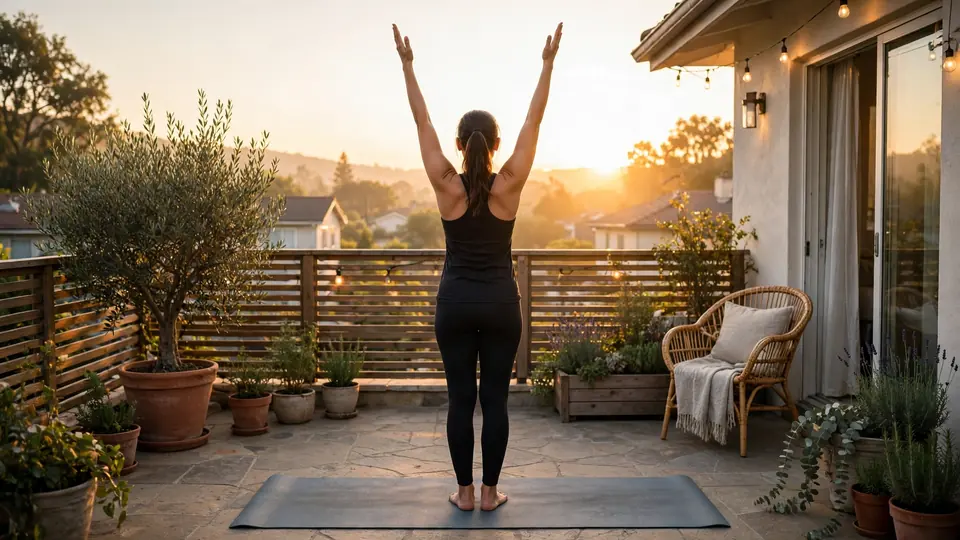
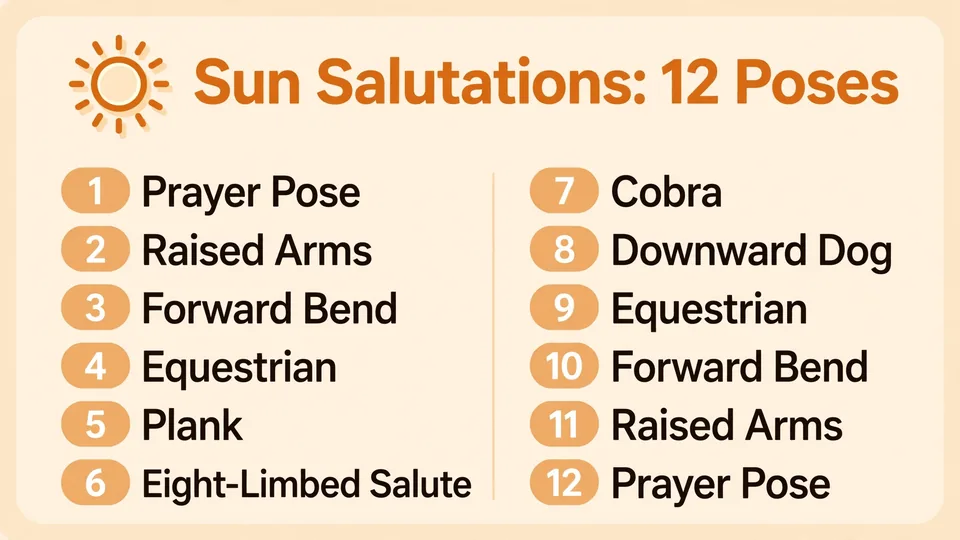
Sun salutations, known in Sanskrit as Surya Namaskar, link 12 yoga poses into one flowing sequence matched to your breath. The practice warms up the whole body in a few minutes, which makes it a practical start to a morning routine or a short standalone workout. This guide walks through each pose, the breathing pattern, and how many rounds to aim for as a beginner.
Key Highlights
- Surya Namaskar is a 12-pose sequence; one full round leads once with the right leg and once with the left.
- Beginners do well starting with 2 to 4 slow rounds and building toward 12 over several weeks.
- Each pose pairs with an inhale or an exhale, so the breath sets the pace, not speed.
- The sequence builds strength, flexibility, balance, and circulation in one short practice.
- Skip or modify the practice if you are pregnant or have a back, shoulder, or wrist injury, and check with a doctor first.
What Surya Namaskar Is and Where It Comes From
Surya means sun and Namaskar means greeting or salutation, so the name describes the intent: a moving greeting to the sun, traditionally practiced at dawn. The sequence strings together standing, bending, lunging, plank, and floor poses so the spine moves through flexion and extension while the arms, legs, and core share the work.
Versions differ by school. Hatha classes teach the classic 12-pose form covered here, while Ashtanga uses Surya Namaskar A and B with jumps and chaturanga. If you are new to the building blocks, our guide to what asanas are and why they matter explains the pose families this sequence draws from.
One half-round runs through the 12 poses leading with the right leg at poses 4 and 9. Repeating the sequence leading with the left leg completes one full round. That left-right balance is why teachers count rounds in pairs.
The 12 Poses, Step by Step
Practice on a mat with enough grip for plank and downward dog; a thin, sticky surface keeps your hands from sliding as you move. Our guide to choosing a yoga mat compares thicknesses and materials if your current mat feels slippery. Move slowly enough that you can breathe through your nose for the full round.
1. Pranamasana (Prayer Pose)
Stand at the front of your mat with feet together and palms pressed at your chest. Breathe normally for a moment and set your intention for the practice. Beginner tip: keep your feet hip-width apart if standing with feet together feels unsteady.
2. Hasta Uttanasana (Raised Arms Pose)
Inhale and sweep your arms overhead, palms facing each other, and lean back slightly from the upper back. Keep your legs firm and your ribs soft. Beginner tip: if your lower back complains, raise your arms straight up and skip the backbend.
3. Hasta Padasana (Standing Forward Bend)
Exhale and fold forward from the hips, bringing your hands toward the floor beside your feet. Bend your knees as much as you need so your belly rests toward your thighs. Beginner tip: touching the floor is optional; a flat back matters more than straight legs.
4. Ashwa Sanchalanasana (Equestrian Pose)
Inhale and step your right leg back into a lunge, lowering the knee to the floor. Press your palms down, lift your chest, and look slightly up. Beginner tip: place a folded blanket under the back knee if the floor feels hard.
5. Dandasana (Plank Pose)
Step the left leg back and form one straight line from head to heels, breathing steadily. Press the floor away and keep your hips level with your shoulders. Your wrists carry real load here, so read our tips to prevent wrist pain in yoga if plank bothers your hands.
6. Ashtanga Namaskara (Eight-Limbed Salute)
Exhale and lower your knees, chest, and chin to the floor while your hips stay lifted. Eight points touch the ground: feet, knees, hands, chest, and chin. Beginner tip: lower down in one slow motion rather than dropping.
7. Bhujangasana (Cobra Pose)
Inhale and slide forward, pressing through your hands to lift your chest into a gentle backbend. Keep your elbows bent and your shoulders away from your ears. Beginner tip: lift only as high as your lower back allows without pinching.
8. Parvatasana (Downward-Facing Dog)
Exhale, tuck your toes, and lift your hips up and back into an inverted V shape. Press your heels toward the floor and lengthen your spine. Beginner tip: bend your knees to keep your back long; straight legs can come later.
9. Ashwa Sanchalanasana (Equestrian Pose)
Inhale and step your right foot forward between your hands, lowering the left knee. Lift your chest as you did in pose 4. Beginner tip: use your hand to help the foot forward if it lands short; this is normal for beginners.
10. Hasta Padasana (Standing Forward Bend)
Exhale and step the left foot forward to meet the right, folding over your legs again. Let your head hang and shake it gently side to side to release your neck.
11. Hasta Uttanasana (Raised Arms Pose)
Inhale, sweep your arms out and up, and rise to standing with a small backbend. Keep your legs active so the lift comes from your whole body, not only your back.
12. Pranamasana (Prayer Pose)
Exhale and return your palms to your chest. You have finished one half-round. Repeat the 12 poses leading with the left leg at poses 4 and 9 to complete a full round, then pause and notice your breath before the next round.
Benefits of a Regular Practice
The sequence works most major muscle groups in a few minutes: legs and glutes in the lunges, arms and shoulders in plank and cobra, and the core throughout. The repeated forward and backward bends move the spine in both directions, which supports flexibility and posture over time.
Research on yoga in general points to modest, real gains. The US National Center for Complementary and Integrative Health notes that yoga may help people manage stress and improve balance, sleep, and mental and emotional health, as its overview of yoga benefits and safety explains. A slow round also counts as light to moderate movement, and the World Health Organization recommends 150 to 300 minutes of moderate aerobic activity a week for adults, so short daily rounds add up toward that target.
Morning practice has its own pull: the sequence raises body temperature and circulation, which shakes off stiffness after sleep. Our look at the benefits of morning yoga covers the wider case for starting the day on the mat.
How Many Rounds and When to Practice
Start with 2 to 4 full rounds at a slow pace. One slow full round takes about 2 to 3 minutes, so a beginner session runs 5 to 10 minutes. Add one round every few days as your breath stays steady, and work toward 12 rounds over several weeks rather than days.
Morning on an empty stomach suits the practice best, since forward bends and cobra feel uncomfortable on a full stomach. Evening rounds also work if mornings are impossible; keep the pace slow so the practice settles you instead of winding you up.
Consistency beats volume. Four rounds every day build more strength and flexibility than 12 rounds once a week, a pattern our daily yoga practice guide for beginners breaks down into a simple weekly plan.
Common Mistakes and Easy Fixes
- Rushing the transitions. Speed hides shaky alignment. Fix: take one full breath per pose.
- Locking the knees in forward bends. Fix: bend your knees and lengthen your spine instead.
- Letting the hips sag in plank. Fix: press the floor away and tuck your tailbone slightly.
- Forcing the backbend in cobra. Fix: keep your elbows bent and lift only your chest.
- Holding your breath. Fix: exhale on folds and lowering, inhale on lifts and lunges.
Breath discipline carries the whole sequence. If coordinating breath and movement feels hard at first, our complete pranayama guide builds the underlying breathing control step by step.
Who Should Be Careful
Skip the full sequence or get medical clearance first if you are pregnant, have a hernia, high blood pressure, a slipped disc, recent abdominal surgery, or an injury to the back, shoulders, arms, or wrists. Practice gently or rest when you have a fever. The NCCIH advises people with health conditions to talk with their health care provider and instructor about individual needs, and that advice applies here: a teacher can swap plank and the eight-limbed salute for safer options.
Frequently Asked Questions
How many sun salutations should a beginner do?
Start with 2 to 4 full rounds, where one full round leads once with the right leg and once with the left. Keep the pace slow enough to breathe through your nose the whole time. Add one round every few days, and aim for 12 rounds over several weeks. Stop and rest if you feel dizzy, sharp pain, or breathlessness.
What is the best time of day to practice?
Morning on an empty stomach is the traditional and most comfortable time, because forward bends and cobra sit badly on a full stomach. An evening practice also works if you keep the pace slow. Avoid vigorous rounds in the hour before bed, since the sequence raises heart rate and body temperature.
Can sun salutations help with weight loss?
They can support weight loss as part of an active routine, but they are not a shortcut on their own. Daily rounds add moderate movement and build muscle across the legs, arms, and core. Weight change still depends on your total weekly activity, sleep, and food, so treat the sequence as one piece of a wider plan.
Is it safe to practice every day?
Yes, daily practice is safe for most healthy beginners when rounds stay slow and pain-free. Keep at least one easier day each week with fewer rounds, and rest fully when you are ill or injured. Muscle tiredness is normal; sharp joint pain is a signal to stop and get advice.
What if I cannot touch my toes or my wrists hurt?
Bend your knees in every forward bend and place your hands on blocks or a chair seat instead of the floor. For sore wrists, make fists or use push-up handles in plank, and swap the eight-limbed salute for a slow lower to the floor. Flexibility and wrist strength improve with practice, so work at today’s range.
How long does one round take?
One slow full round takes about 2 to 3 minutes for a beginner, including both the right-leg and left-leg halves. Experienced practitioners move faster, near one minute per round. Four slow rounds plus a short rest fit inside 10 minutes, which makes the practice easy to keep on busy days.
Conclusion
Start tomorrow morning with 2 slow rounds and add one round every few days. Put your mat where you will see it tonight, set out comfortable clothes, and let the first round be your only job after waking.