
A single repeated sound can steady a restless mind faster than silence alone. That is the promise of mantra yoga, a practice that uses sacred sound as the focus of meditation. This guide explains where it comes from, which mantras matter most, and how to build a daily practice that fits real life.
Key Highlights
- Repeated sacred sound focuses the mind, and the practice traces back to the Vedas, the oldest scriptures of India.
- The word mantra joins the Sanskrit roots man (mind) and tra (tool), so a mantra is a tool for the mind.
- Om, the Gayatri Mantra, and bija seed sounds form the core repertoire for most beginners.
- Japa, the repetition of a mantra with a 108-bead mala, gives the practice its rhythm and structure.
- Research from 2026 links audible mantra repetition with improved vagal tone and sharper cognitive processing.
Where mantra practice begins
Mantras first appear in the Vedas, hymns composed in India more than 3,000 years ago and passed down by spoken word long before they were written. The Rigveda alone holds more than 10,000 mantras, treated as sounds heard by seers in meditation rather than invented. Wikipedia traces the practice to before 1000 BCE.
The Mandukya Upanishad takes Om as its whole subject and calls it the sound of ultimate reality. Patanjali’s Yoga Sutras point the same way: Sutra 1.27 names Om as the sound that stands for the divine, and Sutra 1.28 advises repeating it while reflecting on its meaning. These texts give the practice a clear frame: sound is not decoration for meditation, it is the method itself.
The practice later spread into Buddhism, Jainism, and Sikhism, and Tantric schools built elaborate systems around sound. The core idea stayed constant: a chosen sound, repeated with attention, gathers a scattered mind into one point.
How sound works in the tradition
Yoga calls the study of sound Nada Yoga, the yoga of sound. The teaching is simple: everything vibrates, and the mind follows the vibration it rests on. A mantra gives the mind one steady vibration to hold, so it stops chasing every passing thought.
Tradition describes three ways to chant. Vaikhari is chanting aloud, and it suits beginners because the sound is easy to follow and the body feels the vibration. Upanshu is whispered chanting, quieter and more inward. Manasika is silent mental repetition, held to be the most powerful of the three because nothing external distracts the mind. Most move through all three in one session, starting aloud and letting the sound grow quieter.
Breath sets the pace. So Hum fits one breath, with So on the inhale and Hum on the exhale, while a longer verse such as the Gayatri Mantra takes several slow breaths. Chanting can slow the breath to around six breaths a minute, a rhythm linked with a calm and steady heart rate.
The major mantras and what they mean
A beginner needs only a handful of mantras. Learn one well before adding another.
Om, the sound behind all sound
Om is the oldest mantra and the simplest place to start. Tradition calls it the primal vibration, the sound from which all other sounds arise. Its three parts, A, U, and M, stand for waking, dreaming, and deep sleep, with the silence after the sound standing for pure awareness. Chant it slowly on a full exhale and let it fade into quiet. To understand the symbol and the sound in more depth, read our guide to the meaning of the Om symbol.
The Gayatri Mantra, a prayer for clarity
The Gayatri Mantra is a verse from the Rigveda addressed to Savitar, the sun, asking for light to guide the mind. Its meaning runs close to this: we meditate on the divine light of the sun, may it inspire our understanding.
Many chant it at dawn, noon, or dusk. Its steady rhythm is easy to memorize and hard to rush.
Bija mantras, the seed sounds
Bija mantras are single-syllable seed sounds such as Lam, Vam, Ram, Yam, Ham, and Om. Each one is linked with a chakra, an energy center in the body, and with a quality such as grounding or compassion. Lam pairs with the root chakra and stability, while Ham pairs with the throat chakra and honest speech. These sounds carry no sentence meaning: the effect comes from the vibration itself. Our complete guide to bija mantras explains each seed sound and the chakra it is paired with.
Devotional mantras for the heart
Devotional mantras address a deity or a quality by name. Om Namah Shivaya honors Shiva and is often translated as “I bow to Shiva,” a phrase of surrender and respect. Om Mani Padme Hum, the Buddhist mantra of compassion, is chanted by millions. Hare Krishna, the mantra at the center of the 2026 study cited below, names Krishna and Rama.
Japa and mala practice
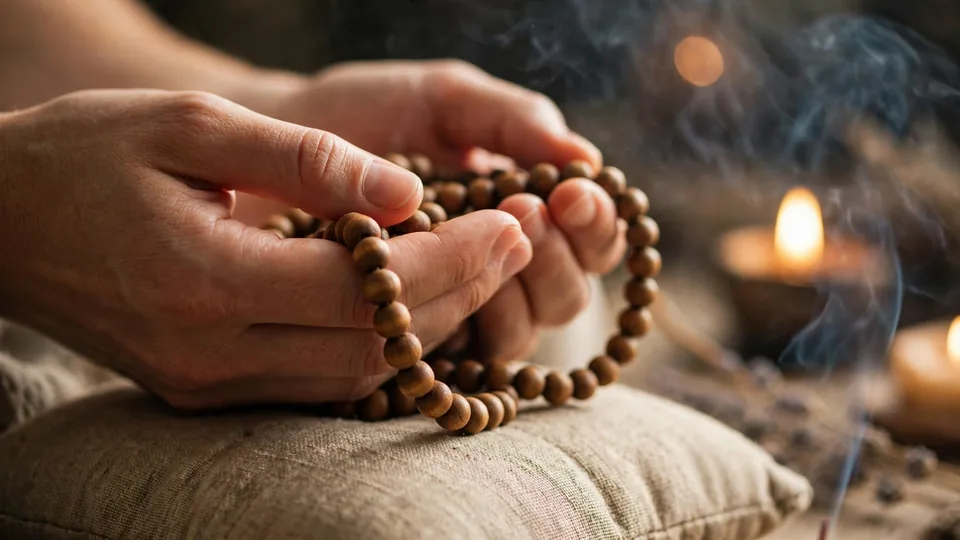
Japa is the repetition of a mantra, counted on a mala, a string of 108 beads. The number 108 has many explanations in the tradition, including the 108 energy lines said to meet at the heart chakra and the 108 sacred sites across India. The count matters less than the rhythm: one bead per repetition, one repetition per breath, and the hand keeps the mind honest when attention drifts.
Hold the mala in the right hand and move one bead forward with the thumb after each repetition, skipping the larger guru bead at the end. Sit on a cushion or a good mat; our guide on how to choose a yoga mat covers thickness and grip for seated practice. A full round takes about 10 to 15 minutes with a short mantra, enough for a daily session, and the beads give beginners a clear finish line.
What regular practice can do for you
Chanting helps on four levels. Mentally, repetition breaks loops of worry and trains attention. Emotionally, slow breath and steady sound calm the nervous system. Physically, chanting links with lower blood pressure, slower heart rate, and better sleep. Spiritually, it builds a sense of connection that silent sitting often fails to give beginners.
Modern research supports several of these claims. A pilot fMRI study at the National Institute of Mental Health and Neurosciences (NIMHANS) found that chanting Om reduced activity in the amygdala and hippocampus, areas tied to stress and emotion, possibly by stimulating the auricular branch of the vagus nerve. A 2026 randomized study in Integrative Medicine compared the Hare Krishna mantra with a look-alike sound and silent meditation in 39 new meditators. The real mantra produced greater gains in heart rate variability and in P300 brain response, a marker of cognitive processing. The study is listed on PubMed at pubmed.ncbi.nlm.nih.gov/42730089, and the authors note that larger trials are still needed.
These findings are promising, not proof of a cure. Chanting complements medical care and does not replace it. A few minutes of daily repetition can lower stress, sharpen focus, and steady the breath, and those effects add up over weeks.
How to start a daily practice
Pick one mantra and one time of day, and protect both for a week. Om is the safest first choice. Morning works best for most people because the mind is quiet, though evening suits those who want to unwind before sleep. For help choosing the right slot, see our guide to the best time to meditate.
Sit with a straight spine on a cushion or a chair. A folded blanket or a good mat makes a long sit far easier. Close your eyes, take three slow breaths, and begin. Chant aloud for the first few minutes, then let the sound soften to a whisper, then to silence if your focus holds. End with one minute of quiet.
Start with five minutes a day and add one minute each week until you reach 15 or 20. A short session done every day beats a long session done once a week.
Common mistakes beginners make
The first mistake is collecting mantras. A new mantra each week splits attention and builds nothing. One mantra, repeated for a month, teaches more than ten mantras tried once each. The second mistake is chasing a perfect accent. Pronunciation matters, but sincerity matters more, and the vibration does its work even when the accent is rough. Listen to a recording a few times, then let the sound settle into your own voice.
The third mistake is forcing the breath. Chanting should never leave you short of air, so shorten a long mantra or split it across two breaths. The fourth is treating the practice as a task to finish. When the mind wanders, return to the sound without scolding yourself. The return itself is the practice.
Sound practice and other forms of meditation
Silent meditation asks the mind to rest on nothing, and that is hard for most beginners. Breath counting gives the mind a job, but the job is dull and the mind soon looks elsewhere. Mantra practice sits between the two: the sound gives the mind a single vivid object, so attention has something to hold without effort. Mindfulness observes thoughts as they pass, while mantra practice replaces passing thoughts with a chosen sound. The two methods can support each other, and a short chant at the start of a mindfulness session settles the mind for the observation that follows. The right method is the one you will actually do each morning. If you want a wider routine around the practice, our guide on how to meditate daily lays out a simple habit structure that pairs well with chanting.
Frequently Asked Questions
What is mantra yoga in simple terms?
Mantra yoga is the use of a repeated sacred sound as the focus of meditation. You chant a word or phrase, aloud or silently, and let the sound hold your attention. It comes from the Vedic tradition of India and uses sound to calm the mind and steady the breath.
Which mantra is best for a complete beginner?
Om is the best first mantra for most beginners. It is one syllable, needs no memorization, and suits every tradition. Chant it slowly on a full exhale for five minutes a day. Once the habit feels steady, you can add the Gayatri Mantra or a bija sound.
How many times should I repeat a mantra each day?
One round of a mala, 108 repetitions, is the traditional daily count and takes about 10 to 15 minutes. Beginners can start with 27 repetitions or a five-minute timer instead. A short daily session beats a long session done once a week.
Do I need to know Sanskrit to chant mantras?
No, you do not need to know Sanskrit. You need to know the meaning of your chosen mantra and how to pronounce it well enough to repeat it. Listening to a recording a few times is enough to learn most short mantras.
Can mantra chanting really reduce stress?
Yes, within limits. Studies link chanting with slower breathing, lower heart rate, and reduced activity in brain regions tied to stress. A 2026 study also found gains in vagal tone and cognitive processing. Chanting supports calm and focus, but it is not a substitute for medical care.
Is mantra yoga a religious practice?
Mantra yoga comes from Hindu, Buddhist, Jain, and Sikh traditions, yet you can practice it without adopting a religion. Many chant for focus and calm alone. If a mantra names a deity, choose a neutral sound such as Om or So Hum instead.
Conclusion
Choose Om, chant it for five minutes tomorrow morning, and repeat that for a week. That small daily habit is the whole practice in miniature, and it will show you more about chanting than any further reading can.