
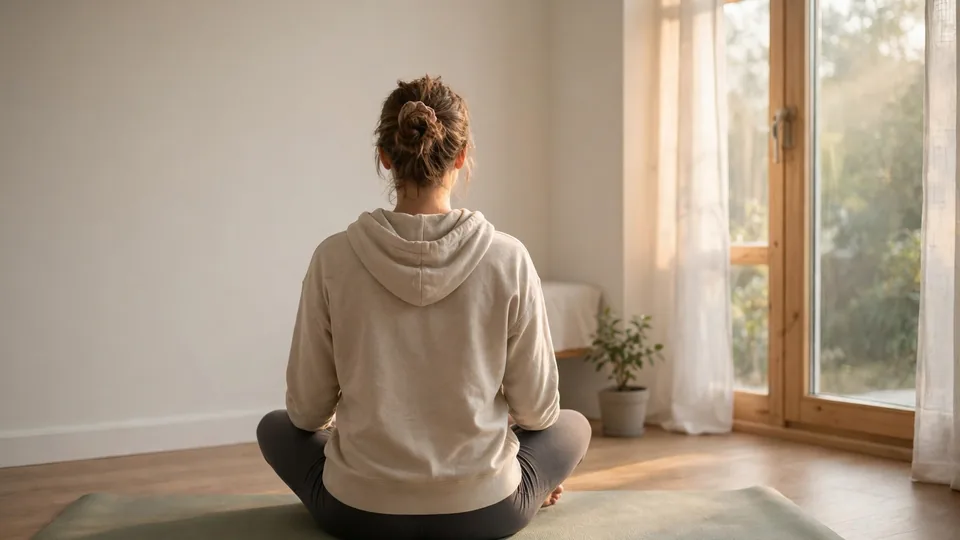
A daily yoga practice does not need an hour, a studio, or flexibility you do not have yet. It needs ten minutes, one corner of your home, and a time you can repeat tomorrow. This guide shows you how to build that habit from nothing: a simple 20-minute routine for beginners, a fixed time that fits your day, and a way to keep going on mornings you would rather skip.
Key Highlights
- Start with 10 minutes a day. A short practice you repeat beats a long one you quit.
- Practise at the same time every day, anchored to something you already do.
- Keep your mat in one small corner so starting takes no effort at all.
- Follow the 20-minute routine below: breathe, warm up, sun salutations, standing poses, rest.
- Miss a day without drama. The next morning is the practice.
Start With Ten Minutes, Not an Hour
Most beginners quit in the first two weeks, and the reason is rarely laziness. Day one is an hour-long video, day two brings sore muscles, and by day three the mat stays rolled up. A practice that asks too much on day one has no day thirty. Ten minutes asks almost nothing, and that is the point. You can do ten minutes on a bad morning or a busy one. The habit forms because the bar is low enough to clear every day.
Habit research backs the small start. Researchers at University College London tracked people building new habits and found it took 66 days on average for a behaviour to feel automatic, with a wide range from 18 to 254 days. The people who succeeded were not the ones who tried hardest in week one. They were the ones who repeated a small action often enough for it to stick.
Set your first goal at ten minutes, not thirty. Do the breathing and warm-up from the routine below, add one round of sun salutations, and rest. When ten minutes feels easy for two straight weeks, stretch it to fifteen, then to the full twenty. Let the practice grow at a pace you can hold.
Pick One Time and Anchor It
A practice without a time is a wish. Pick the slot you can protect most days and write it down: 6:30 before breakfast, 7:00 after the children leave, or 9:00 at night when the house quiets. Morning suits most beginners because the day has not filled up yet and the practice sets a calm tone for everything after it. Our guide to the benefits of morning yoga explains why that early slot works so well.
Then anchor the new habit to something you already do without thinking. After you brush your teeth, you roll out the mat. After you make tea, you sit and breathe. The anchor matters more than willpower because it removes the daily decision. You do not ask yourself whether to practise. The toothbrush ends, the mat begins, and the choice is already made.
Evenings work too, as long as the practice stays gentle. A slow evening session with seated forward folds and legs up the wall helps the body unwind, but a fast, sweaty flow an hour before bed can leave you wired. Match the practice to the time of day, and keep the time itself fixed.
Set Up a Corner You Can Return To
You do not need a yoga room. You need a patch of floor about the size of a mat, in a spot you pass every morning, where the mat can stay unrolled. A corner near a window works well: daylight, fresh air, and enough space to stretch your arms wide without hitting furniture. If you are choosing your first mat, read our guide on how to choose a yoga mat before you buy, since grip and thickness matter more than colour or price.
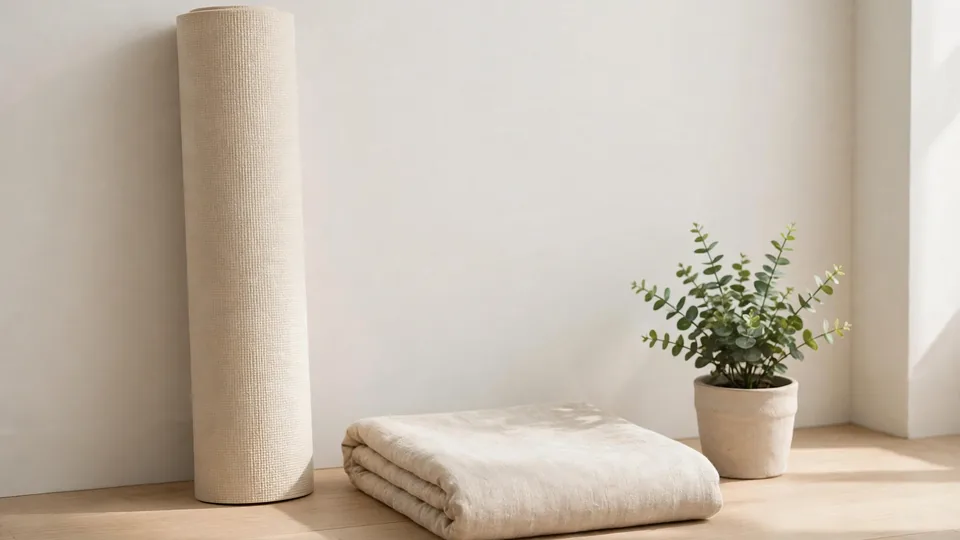
Keep three things in that corner and nothing else: the mat, a folded blanket for sitting and kneeling, and a cushion or block if you have one. The test is simple. Can you start practising within thirty seconds of deciding to? If the mat is buried in a cupboard, the practice will lose to friction every morning. Make starting easy and the habit does the rest.
Your 20-Minute Daily Yoga Practice
This is the routine to follow once ten minutes feels easy. It has five parts and needs no props beyond a mat and a blanket. Twenty minutes a day adds up to 140 minutes a week, close to the World Health Organization guideline of 150 to 300 minutes of moderate activity a week for adults, and yoga counts toward it. Move slowly, breathe through your nose, and stop any movement that hurts.
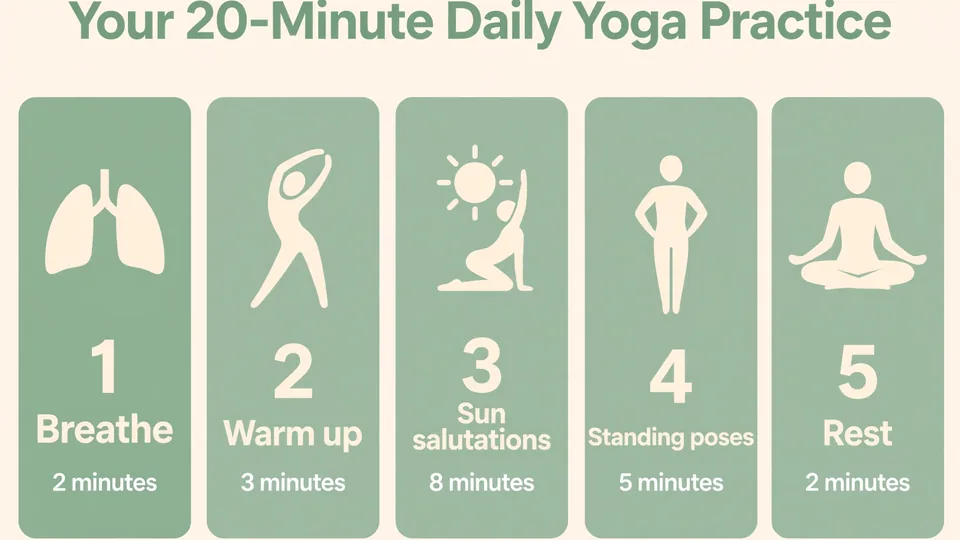
Step 1: Breathe for 2 Minutes
Sit cross-legged on your blanket with a tall spine and soft shoulders. Close your eyes and breathe in for four counts, out for six. Let the belly rise first, then the ribs, then the chest. Two minutes of slow breathing settles the nervous system and marks the line between your day and your practice. If your mind races, count the breaths and start again at one.
Step 2: Warm Up for 3 Minutes
Come to hands and knees for cat-cow: round the spine on the exhale, lengthen it on the inhale, six slow rounds. Add gentle neck rolls and shoulder circles, then sit back into child’s pose for five breaths. Skipping the warm-up is how beginners strain a back or a wrist.
Step 3: Sun Salutations for 8 Minutes
Do three to four rounds of classical sun salutation at a slow, steady pace, one breath per movement. Bend your knees generously in forward folds and step back to plank instead of jumping if that feels safer. The sequence links breath to movement and warms the whole body. Rest in child’s pose between rounds whenever you need it.
Step 4: Standing Poses for 5 Minutes
Hold three standing poses, five slow breaths each. Try mountain pose with arms reaching up, warrior two with a steady gaze over the front hand, and a wide-legged forward fold with bent knees. Keep the knees soft and the spine long. Standing poses build leg strength and balance, and teach the alignment that protects your knees and lower back.
Step 5: Rest for 2 Minutes
Lie on your back in savasana with your legs extended and your palms facing up. Let your whole body soften into the floor and breathe normally. Two minutes is short, but it matters: rest lets the body absorb the practice and teaches the mind to be still. Our yoga meditation basics guide shows how to extend this stillness into a short seated meditation when you are ready.
Add Breath and Stillness as You Settle In
After two or three weeks of the routine above, add five minutes of breathwork before your final rest. Start with simple belly breathing or the equal breathing from our complete guide to pranayama, where the inhale and exhale are the same length. The Yoga Sutras say practice becomes firmly grounded when it is done over a long time, without interruption, and with earnestness.
Then add stillness. Sit for five minutes after savasana and simply watch your breath, without trying to control it. Harvard Health Publishing notes that yoga improves strength, balance, and flexibility while easing stress, and the quiet minutes at the end of a session are where much of that stress relief happens. If sitting still feels hard, follow a short guided meditation first. Our guide on how to meditate daily gives a plain method for building that second habit alongside the first.
What to Do on Days You Want to Skip
Some mornings you will not want to practise. That is normal, and it is not a sign the habit is failing. The rule for those days is simple: do the five-minute version. Two minutes of breathing, one round of sun salutation, and a short rest. Five minutes keeps the chain unbroken and reminds your body what the practice feels like. Most days, you will find you want to continue once you have started.
Real rest days count too. One full rest day a week is sensible for a beginner, especially if your muscles are sore. The danger is not one rest day. It is the second skipped day, which turns into a skipped week. If you miss a day, do not double up the next day to make up for it. Just show up at the usual time. If your practice has gone quiet for weeks, our guide on how to reboot your yoga practice walks through a gentle restart.
Mistakes That Break a New Practice
The first mistake is doing too much too soon. An hour-long advanced video on day three leaves you sore, discouraged, and convinced yoga is not for you. The second is copying someone else’s practice. The flexible teacher on screen has practised for years. Your practice should match your body today, with bent knees and blocks where you need them. The third mistake is practising on a full stomach. Wait two to three hours after a main meal.
The fourth mistake is skipping savasana because it looks like doing nothing. Rest is part of the practice, not a reward for finishing it. The fifth is measuring progress by flexibility. Touching your toes is a poor measure of a practice that is really about steadiness, breath, and showing up. Judge your practice by whether you returned to the mat this morning.
Conclusion
Build on ten minutes at one fixed time in one small corner, then grow to the twenty-minute routine above. Roll out your mat tomorrow at the same time and do the ten-minute version. That single repeat is the practice.
Frequently Asked Questions
How long should a beginner practise yoga each day?
Start with 10 minutes a day. That is enough for breathing, a short warm-up, and one or two rounds of sun salutation. When 10 minutes feels easy for two weeks in a row, add five minutes at a time until you reach 20 to 30 minutes. Short daily sessions build the habit far better than occasional long ones.
Is 20 minutes of yoga a day enough?
Yes. Twenty minutes a day gives you 140 minutes a week, close to the World Health Organization guideline of 150 to 300 minutes of moderate activity weekly for adults. A steady 20-minute routine covers breath, mobility, strength, and rest, which is a complete practice for most beginners.
What is the best time of day to practise yoga?
The best time is the one you can repeat every day. Morning works for most beginners because the day has not filled up yet and the practice sets a calm tone. Evening practice works too if you keep it slow and gentle. Pick one time, anchor it to an existing habit, and protect it.
Can I do yoga every day as a beginner?
Yes, if you keep it gentle and listen to your body. Daily practice is safe for beginners when sessions are short, poses are simple, and you rest in savasana at the end. Take one full rest day a week if your muscles feel sore, and use a five-minute version on low-energy days instead of skipping entirely.
Do I need equipment to start a daily yoga practice at home?
No. A non-slip mat is the only thing worth buying at the start, and even that can wait if you have a clean, grippy floor. A folded blanket works for sitting and kneeling, and sturdy books can stand in for blocks. Add props only when a pose shows you need one.
How long does it take for yoga to become a habit?
About two months on average. University College London research found a new habit takes 66 days on average to feel automatic, though the range runs from 18 to 254 days. Practising at the same time every day, even for ten minutes, shortens that path more than any single long session.