
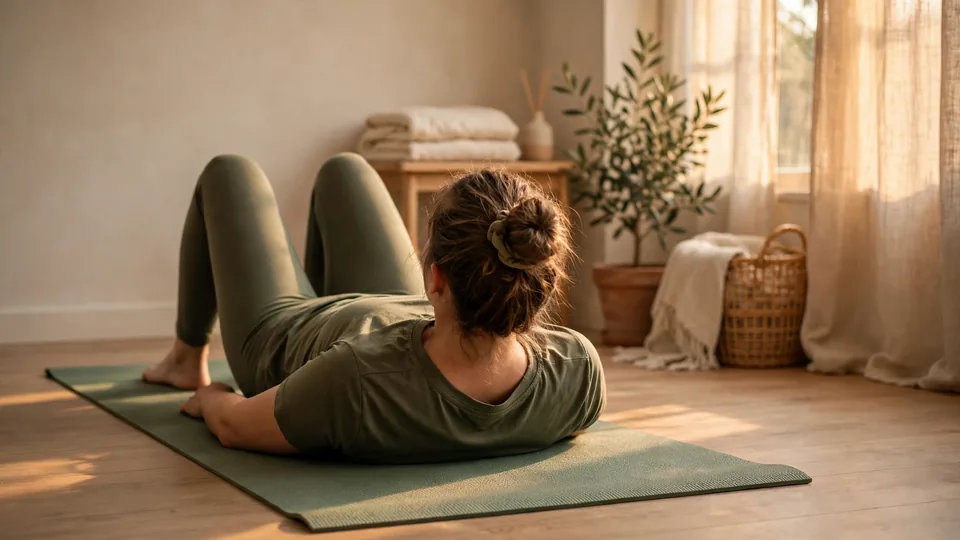
Most tight shoulders and stiff backs are habits, not damage. Somatic yoga works on the habit itself: slow, small movements paired with close attention teach your nervous system to release tension it has learned to hold. This guide explains what the practice is, how it differs from a regular class, and a short sequence to try at home, with no flexibility required to begin.
Key Highlights
- Somatic yoga prioritizes internal sensation over pose shapes, so effort stays low and awareness does the work.
- Its core technique is pandiculation: contract a muscle gently, release it very slowly, then rest.
- Slow movement retrains the habitual tension patterns Hanna called sensory motor amnesia.
- Sessions are short and floor-based; 10 to 15 minutes, three to five times a week, is a realistic start.
- It suits beginners, desk workers, older adults, and anyone whose stiffness returns after ordinary stretching.
What Somatic Yoga Is
The word somatic comes from the Greek soma, meaning the body as it is lived and felt from within. Movement theorist Thomas Hanna coined the term somatics in 1976 for methods that build awareness and voluntary control from the inside. Somatic yoga applies that idea to yoga: what matters is the sensations you notice while moving, not the pose itself.
Sessions are usually floor-based and unhurried. You might rock the pelvis a few millimetres, roll one shoulder slowly, or contract and release one muscle group, then pause to register what changed. Cleveland Clinic describes it as an approach where the process matters more than athletic proficiency: progress is measured in awareness and ease, not in how a shape looks.
How It Differs From Regular Yoga
Regular classes organize practice around asanas: named postures you enter, align, and hold, often flowing in sequences that build heat and strength. Somatic yoga borrows some of those shapes but changes the goal. Instead of pulling a tight muscle longer, you contract it gently and release it slowly, which tells the brain how much tension that muscle actually needs.
Movements stay small, effort stays around 30 to 60 percent of your maximum, and rests between repetitions are part of the method, not a break from it. Where a stretch asks how far this can go, a somatic movement asks how clearly you can feel it, and how fully you can let go.
The Core Principles
Pandiculation: the contract, release, rest cycle
Pandiculation is the technique at the center of the practice. You contract a muscle on purpose, release it as slowly as you can, then rest completely for a few breaths. Animals do a version of this on waking: the full-body stretch and yawn that resets their muscles. Done on purpose, that slow release tells the brain it can lower the muscle’s resting tension.
Slow, mindful movement
Speed hides sensation. Moving slowly gives your nervous system time to register what is happening, and keeps you in a comfortable range where the body does not brace against the movement. If you cannot feel a muscle, you cannot change how it behaves, so slowness is a requirement, not a mood.
Interoception: sensing from the inside
Interoception is your perception of signals from inside the body: heartbeat, breath, hunger, and background muscular tension. Somatic practice trains it directly. Each pause after a movement is practice: compare one side with the other and notice warmth, heaviness, or ease. Proprioception, your sense of position in space, sharpens alongside it.
Sensory motor amnesia: why tension becomes a habit
Hanna used the term sensory motor amnesia for muscles held tight so long that the brain forgets they are contracted at all. Desk work, old injuries, and repeated stress responses train this pattern: shoulders creep up, the lower back braces, the jaw sets. Because the contraction is habitual, willpower and ordinary stretching rarely switch it off. Pandiculation works because it makes the contraction voluntary and noticeable first, which restores the brain’s option to release it.
Benefits of a Regular Practice
The most consistent benefit people report is less background tension: a neck that no longer aches by mid-afternoon, a lower back that feels less guarded in the morning. Because the movements restore voluntary control rather than forcing range, mobility improves as a side effect. If stiffness is your main complaint, pairing this practice with simple mobility exercises to reduce stiffness on alternate days covers both control and range.
The practice also downshifts the stress response. Slow movement, longer exhales, and attention on neutral sensations tell the nervous system nothing urgent is happening. Breathing often gets deeper as the rib cage and diaphragm let go, and an evening session can make falling asleep easier. For a fuller wind-down, follow it with a bedtime yoga routine for better sleep once or twice a week.
A Sample Sequence of Somatic Movements
Try this 12-minute floor sequence in order, at low effort, resting two or three breaths after each movement. Stop if anything produces sharp or shooting pain. If the floor is difficult, most of these movements have seated versions, and our guide to chair yoga exercises and benefits shows the adaptations.
1. Constructive rest and body scan
Lie on your back with knees bent and feet flat, arms by your sides. Spend a minute scanning from feet to head, noting where the floor feels firm and where you are holding yourself up by effort. This baseline makes changes easier to spot.
2. Arch and flatten
With feet planted, gently arch your lower back so a small space opens under it, then slowly flatten it toward the floor. Rock between the two positions eight to ten times, smaller and slower each round. This pandiculates the muscles along the spine and pelvis.
3. Shoulder shrug release
Inhale and shrug both shoulders toward your ears at about half effort. Hold for two seconds, then release over a slow count of five to seven, as if the shoulders were melting downward. Rest, notice where they settle, and repeat six times.
4. Windshield wiper knees
With feet a little wider than your hips, let both knees drift slowly to the right, only as far as stays comfortable, then return to center and drift left, six times per side, for gentle rotation in the hips and lower back.
5. Open book rib roll
Lie on your left side with knees bent and stacked, arms in front of you, palms together. Open your chest toward the ceiling, letting the right arm arc behind you only as far as feels easy. Return slowly. Repeat five times, then change sides.
Who Somatic Yoga Suits
It suits people whose stiffness keeps coming back: desk workers, drivers, and anyone who stretches the same tight spots daily with little to show for it. Beginners do well: no flexibility prerequisite, no sequence to memorize. Older adults often find the floor-based, low-effort format manageable, and it pairs well with the priorities in our guide to yoga for healthy aging: balance and joint comfort first.
It also suits people rebuilding confidence after a minor injury, once cleared for gentle movement, and anyone who finds fast classes overwhelming. If you want intensity, heat, and a workout effect, a vinyasa class will serve you better.
How to Start at Home
You need a quiet patch of floor, comfortable clothes, and a surface with some padding. A firm mat helps you feel the contact points clearly; our guide to choosing a yoga mat explains thickness and grip if you are buying your first one. A folded blanket is the only other prop most people need.
Start with 10 to 15 minutes, three times a week, and pick one area per session, such as neck and shoulders one day, back and hips the next. Progress by moving more slowly and sensing more detail, not by pushing range. The same patience principle runs through our tips on how to get better at yoga: consistency with attention beats occasional long sessions.
Safety Notes
Stay in the 0 to 3 range on a 0 to 10 discomfort scale, keep breathing easily, and keep your face and jaw soft: those are green lights. Pinching, numbness, tingling, shooting pain, breath holding, or dizziness are red lights: stop, rest, and skip that movement.
Ask a clinician or an experienced somatic teacher first if you are pregnant, recovering from recent surgery, or managing an acute injury, severe undiagnosed pain, or nerve symptoms such as radiating numbness. This practice supports general comfort; it does not diagnose or treat medical conditions.
Conclusion
Run the sequence above three times this week and judge it by how your body feels an hour later, not by how the movements look. Pick your first session time now and begin with the body scan.
Frequently Asked Questions
What is the difference between somatic yoga and regular yoga?
Somatic yoga focuses on internal sensation and releasing tension, while regular yoga focuses on performing and holding postures. In a regular class you work toward alignment, strength, and flexibility in named poses. In a somatic session you move slowly through small contractions and releases, resting often, so the nervous system learns to lower habitual tension. The shapes can look similar; the intention and the pace are different.
Is somatic yoga good for chronic pain?
It can help some people manage chronic muscle tension and related discomfort, but it is not a medical treatment. By restoring voluntary control over habitually tight muscles, the practice often reduces the background ache that comes from guarding and bracing. Evidence and clinical guidance, including Cleveland Clinic’s overview, treat it as a supportive practice. Persistent, severe, or unexplained pain still needs assessment by a healthcare professional.
How often should I practice somatic yoga?
Three to five short sessions a week is a good target for most beginners. Sessions of 10 to 20 minutes are long enough, because the learning happens through attention rather than exertion. Daily practice is fine at this low intensity, and many people prefer a brief daily session to one long weekly class. What matters most is regularity over several weeks, since you are retraining habits.
Do I need to be flexible to start somatic yoga?
No, you do not need any flexibility to start somatic yoga. The movements are small, floor-based, and done inside a comfortable range, so tightness is not a barrier. In fact, people who feel too stiff for regular classes often progress fastest, because the practice asks for noticing rather than range. Wear comfortable clothes, use a padded surface, and let each movement stay easy.
What is pandiculation, and why does it matter?
Pandiculation is a deliberate contraction of a muscle followed by a very slow release and complete rest. It matters because the slow release gives the brain clear sensory feedback, which lets it lower the muscle’s resting tension. It is the pattern animals use when they stretch and yawn after sleep. Unlike passive stretching, pandiculation changes the instruction the brain sends to that muscle instead of pulling it longer.
Can I do somatic yoga if I am pregnant or recovering from an injury?
Yes, in many cases, but check with your clinician or an experienced teacher first. Pregnancy and injury recovery change which positions and ranges are appropriate, and some movements need adaptation or should be skipped. Once you are cleared for gentle movement, the low-effort, comfort-led nature of this practice makes it a reasonable option. Stop any movement that causes pain, numbness, tingling, or dizziness.