
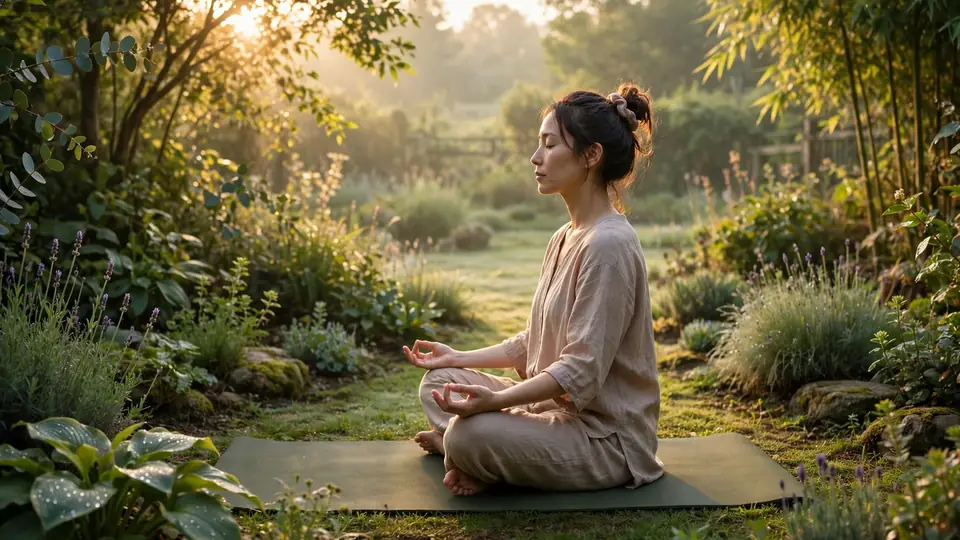
The yoga sutras are 196 short lines that explain what yoga is and how to practice it, written down by the sage Patanjali about 1,600 years ago. Most people meet only one small part of the text, the eight limbs, in a yoga class. The full work reads in an afternoon and rewards years of study. This guide explains it in plain language, walks through each limb, and ends with a simple way to start this week.
Key Highlights
- The Yoga Sutras are 196 aphorisms in four chapters, compiled by Patanjali between 200 BCE and 400 CE.
- Sutra 1.2 defines yoga as the stilling of the fluctuations of the mind.
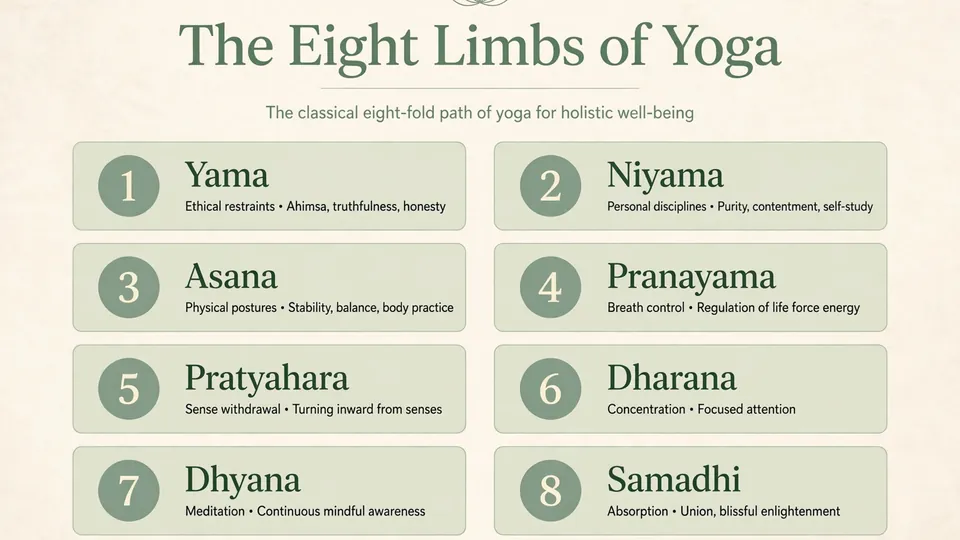
- The eight limbs, listed in Sutra 2.29, run from ethics to absorption: yama, niyama, asana, pranayama, pratyahara, dharana, dhyana, samadhi.
- Asana is only one limb, and Patanjali gives it three sutras: a posture should be steady and comfortable.
- Start with one limb this week: pick one yama, sit for five minutes, and breathe slowly before bed.
What Are the Yoga Sutras?
Patanjali’s text is 196 sutras, short threads of teaching, in four chapters: Samadhi Pada, on absorption; Sadhana Pada, on practice; Vibhuti Pada, on powers; and Kaivalya Pada, on liberation. Scholars date the compilation to between 200 BCE and 400 CE, often to around 400 CE. Patanjali probably gathered and ordered older teachings rather than inventing them from nothing. The opening line sets the tone: “Atha yoga anushasanam,” now the teaching of yoga begins. Our guide to Sutra 1.1 looks at that first line.

The second sutra gives the definition the whole book turns on: “Yogas chitta vritti nirodhah.” Yoga is the stilling of the fluctuations of the mind. The mind is always moving: planning, remembering, judging, wanting. Yoga is the practice of letting those movements settle until the mind rests clear. Everything that follows is a method for getting there. Sutra 1.33 offers four attitudes for a steady mind: friendliness toward the happy, compassion for the suffering, joy for the virtuous, and equanimity toward those who act badly. It is practical advice, and it works as well off the mat as on it.
The Eight Limbs of Yoga
Sutra 2.29 names the eight limbs in order: yama, niyama, asana, pranayama, pratyahara, dharana, dhyana, samadhi. The order moves from the outside in: how you treat the world, how you treat yourself, the body, the breath, the senses, then the mind itself. The first five are the outer limbs, and the last three the inner limbs. When the last three happen together on one object, Patanjali calls them samyama. Each limb supports the next, and none is a test to pass before moving on.
1. Yama: How You Treat Others
The yamas are five restraints, listed in Sutra 2.30: ahimsa, non-harming; satya, truthfulness; asteya, not stealing; brahmacharya, moderation of desire; aparigraha, non-possessiveness. Patanjali calls them the great vow when practiced everywhere, at all times, toward everyone, with no exceptions. That is a high bar, and the point is direction, not perfection. Ahimsa comes first for a reason. A practice built on harming others cannot settle the mind, because guilt and conflict keep it moving. In daily life, a yama can be as small as speaking carefully in one conversation.
2. Niyama: How You Treat Yourself
The niyamas turn inward. Sutra 2.32 lists five observances: shaucha, cleanliness; santosha, contentment; tapas, disciplined effort; svadhyaya, self-study; ishvara pranidhana, surrender to something larger. Where the yamas restrain, the niyamas build. Contentment is the most useful one for a beginner. It means wanting what you already have long enough to notice it, the direct opposite of the restless wanting that keeps the mind moving. Our guide to the five niyamas explains each one with examples from ordinary days.
3. Asana: A Steady, Comfortable Seat
Here is the limb most people know, and Patanjali’s teaching on it fits in three sutras. Sutra 2.46 says it in three words: “sthira-sukham asanam.” A posture should be steady and comfortable. That is all. The text says nothing about handstands or flexibility. The seat exists so the body can stay still for breath and meditation, and a seat that hurts defeats its purpose. Modern classes spend most of their time on this one limb, which is fine as long as it is remembered as one of eight. A yoga mat that stays put helps, since a sliding mat pulls attention back to the body at the exact moment the practice asks you to forget it.
4. Pranayama: Lengthening the Breath
Pranayama comes after the seat is steady. Sutra 2.49 describes it as the regulation of the in-breath and the out-breath once the posture is secure. The word is usually translated as breath control, but it means extending the life force, prana, and the breath is the handle you hold. Slow breathing with a long exhale settles a busy mind faster than almost anything else, which is why teachers place breathing between the physical practice and sitting meditation. Our complete guide to pranayama sets out the classical techniques, ratios, and safety rules in one place.
5. Pratyahara: Turning the Senses Inward
Pratyahara is the withdrawal of the senses from their objects. Sutra 2.54 compares it to a tortoise drawing its limbs into its shell. The senses do not switch off. They stop chasing every sound, sight, and notification, and attention turns inward. Anyone who has closed their eyes in a quiet room and felt the world go soft has touched this limb. It is the hardest limb to practice in a modern home, because phones and screens are built to pull the senses outward. A closed door, a silent phone, and five minutes are enough to begin.
6. Dharana: Holding the Mind on One Point
Dharana is concentration, defined in Sutra 3.1 as holding the mind on one place or object. The breath, a candle flame, a mantra, or a single point on the wall all work. The mind will wander. Each time you notice it has gone and bring it back, that return is the practice. Most people who say they meditate are practicing dharana, and that is normal. Concentration is a skill, and it strengthens like a muscle, through short repeated effort rather than one heroic session.
7. Dhyana: Meditation Without a Break
Dhyana is what happens when concentration holds without breaking. Sutra 3.2 describes it as an unbroken flow of attention toward the object, like oil poured in a steady stream. The difference is duration, not technique. Hold the mind on the breath for a few seconds and you are in dharana. Hold it for minutes without losing the thread and it is dhyana. If sitting still is new to you, the basics of meditation pair naturally with this limb as a short daily routine.
8. Samadhi: Absorption
Samadhi is the last limb, and the one most often misunderstood. Sutra 3.3 says that when even the sense of a separate meditator falls away and only the object shines, that is samadhi. It is not a trance or a reward for good behavior. It is what remains when the mind stops commenting on its own experience. Together they form samyama, and Patanjali spends the third chapter describing what mastery of samyama can do. Treat samadhi as a direction, not a prize to chase. Chasing it is itself a fluctuation of the mind, the very thing the practice is meant to still.
How to Bring the Eight Limbs Into One Week
Few people start with the yamas. Most walk into a class for the body and meet the other limbs along the way. A realistic week touches five limbs without adding an hour to your day. Pick one yama, ahimsa, and notice where you could cause less harm in one conversation. Pick one niyama, santosha, and name one thing you already have before reaching for something new. Take one asana class of twenty to sixty minutes, keeping each pose steady and easy. After class, sit for five minutes of slow breathing, then five minutes with eyes closed and attention on the breath. That last stretch covers pratyahara, dharana, and the start of dhyana in one quiet sit.
Expect the week to go unevenly. Some days the sit will feel calm, and some days the mind will race the whole five minutes. The sutras have a word for the fix: vairagya, letting go of the result. Our four-step guide to vairagya explains how to release attachment to how a session should feel. You do not have to perfect the ethics before you are allowed on the mat, or perfect the mat before you are allowed to sit still. Start anywhere and let the limbs meet you there.
Common Mistakes to Avoid
The most common mistake is treating asana as the whole of yoga. A strong physical practice with no attention to breath, ethics, or stillness is exercise, and it is not what the sutras describe. A second mistake is reading without practicing. The text is short and the ideas are clear, so it is tempting to collect knowledge about the limbs instead of living one for a week. A third mistake is turning the yamas and niyamas into rigid rules, then feeling guilty for breaking them. They are practices to return to, not commandments to keep perfectly. A fourth mistake is chasing samadhi as a goal. The last limb arrives on its own schedule, and chasing it keeps the mind moving.
Frequently Asked Questions
How long does it take to read the Yoga Sutras?
One afternoon is enough to read all 196 sutras in a plain modern translation, since the whole text is only a few thousand words. Understanding them takes longer, which is why most editions pair each sutra with commentary. Read the text straight through once, then study it slowly, a few sutras at a time.
Do I need to know Sanskrit to study the Yoga Sutras?
No, a good translation is enough to begin, and most students start that way. Learning a few key terms helps over time, because words like chitta, vritti, and samadhi carry meanings that no single English word holds. You can pick those terms up gradually as you read, without studying the language formally.
Are the eight limbs meant to be practiced in order?
They are presented in order but practiced together, not one after another. Patanjali lists ethics first because a settled conscience makes sitting still easier, yet most people enter through asana or pranayama and meet the rest later. Start with the limb that is easiest to reach, and let it lead you to the rest.
What is the difference between dharana, dhyana, and samadhi?
Dharana is holding the mind on one object, dhyana is that holding flowing without a break, and samadhi is when even the sense of a separate meditator falls away and only the object remains. They are three stages of one deepening attention, together called samyama. Most daily practice sits in dharana, with moments of dhyana, and that is exactly as it should be.
Is Patanjali the founder of yoga?
No, yoga predates Patanjali by centuries, and the ideas in the sutras appear in older texts like the Upanishads and the Bhagavad Gita. Patanjali’s achievement was to gather these teachings into one short, ordered system and give it a clear method. Think of him as an editor and systematizer rather than an inventor.
Which translation of the Yoga Sutras should a beginner read?
Start with a plain modern translation with commentary, such as Swami Satchidananda’s The Yoga Sutras of Patanjali or Edwin Bryant’s translation. B.K.S. Iyengar’s Light on the Yoga Sutras is a fuller study edition for later. Pick one translation, read it through, and stay with it rather than switching between editions.
A Simple Place to Start
Read Sutra 1.2 tonight, then sit five minutes and watch the breath. Tomorrow, pick one yama and carry it through a single day. That small loop is the whole path in miniature, and it is enough to begin.