
Introduction
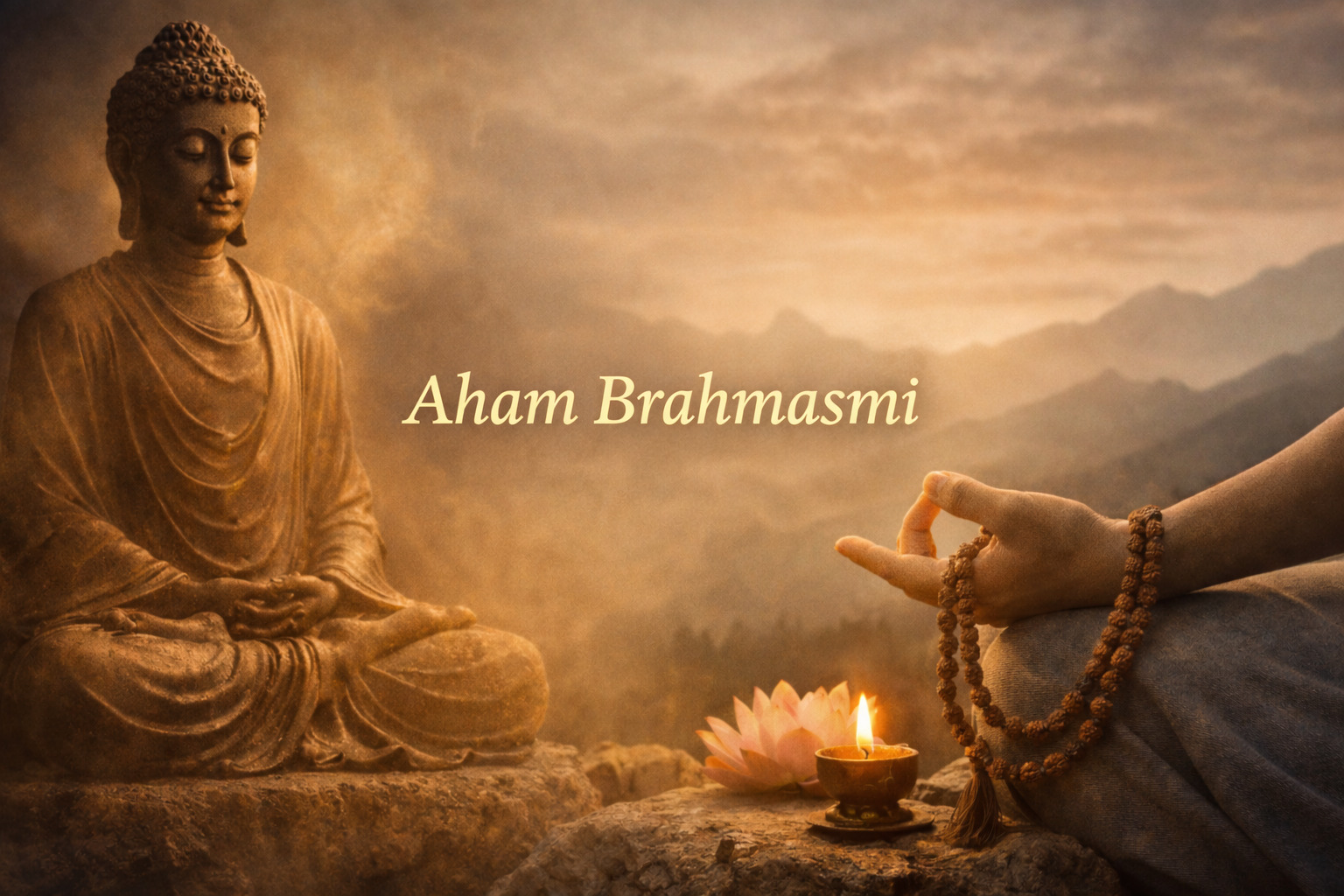
The Aham Brahmasmi mantra (अहं ब्रह्मास्मि) stands as one of the most profound declarations in Indian spiritual philosophy. Rooted in the ancient Brihadaranyaka Upanishad of the Yajur Veda, this mantra is revered as one of the four Mahavakyas, or “Great Sayings,” that articulate the essence of Advaita Vedanta—the philosophy of non-duality.
More than a chant or affirmation, Aham Brahmasmi is a direct statement of ultimate truth. It does not describe reality symbolically or metaphorically; it points directly to the realization that the individual self (Atman) and the universal consciousness (Brahman) are not two separate entities, but one and the same.
In a world shaped by identity, comparison, and division, this mantra invites the seeker to transcend surface-level distinctions and awaken to an unchanging, universal essence that underlies all existence.
Literal Meaning of Aham Brahmasmi
The mantra breaks down into three simple yet philosophically loaded components:
- Aham – “I”
- Brahma (Brahman) – the ultimate reality, absolute consciousness, infinite and eternal
- Asmi – “am”
Together, Aham Brahmasmi translates to:
“I am Brahman.”
This statement is not an egoic claim of divinity. Instead, it negates the ego altogether. It asserts that when all false identifications—body, mind, roles, and stories—are stripped away, what remains is pure consciousness, identical with the cosmic whole.
Philosophical Authority: A Mahavakya of Advaita Vedanta
In the Vedantic tradition, a Mahavakya is not meant for casual repetition alone. It is a teaching device used for deep contemplation (nididhyasana) under the guidance of inquiry and discernment.
Atman and Brahman Explained
- Atman is the innermost Self—beyond personality, memory, and mental activity.
- Brahman is the infinite, formless ground of all existence.
Advaita Vedanta teaches that the perceived separation between Atman and Brahman is a result of Avidya (ignorance). This ignorance manifests as Maya, the illusion that we are isolated individuals moving through a fragmented world.
Aham Brahmasmi directly dismantles this illusion.
When realized—not merely repeated intellectually—it leads to Jnana, or liberating knowledge, which is considered the highest form of freedom (Moksha).
Aham Brahmasmi as a Tool for Self-Inquiry
Unlike devotional mantras that invoke an external deity, Aham Brahmasmi is introspective and revelatory. It does not ask for grace; it reveals what is already true.
The mantra works as a pointer—a verbal arrow directing awareness back to its source.
When contemplated deeply, it raises fundamental questions:
- Who is the “I”?
- Is the self limited to the body and mind?
- What remains when thoughts dissolve?
This inquiry lies at the heart of Jnana Yoga, the yogic path of wisdom.
How to Practice the Aham Brahmasmi Mantra
To experience the transformative potential of Aham Brahmasmi, practice must go beyond mechanical repetition and move toward embodied awareness.
1. Prepare the Space and Body
Choose a quiet, clean space where you will not be disturbed. Sit comfortably with a straight spine—on a cushion or chair. Let the body be relaxed but alert.
2. Settle the Breath
Close your eyes and begin slow, rhythmic breathing. Allow the breath to soften mental agitation and anchor awareness in the present moment.
3. Mantra Repetition
Repeat Aham Brahmasmi:
- Aloud (for vibrational resonance)
- In a whisper
- Or silently (most subtle and powerful)
Let each word align with the breath:
- Inhale: Aham
- Exhale: Brahmasmi
4. Contemplative Absorption
Rather than forcing meaning, rest in the feeling of unity. Observe sensations, thoughts, and emotions arise and dissolve within awareness itself.
5. Use of Mala Beads
Chanting the mantra 108 times using a mala can deepen concentration, rhythm, and continuity of awareness.
Even 10–15 minutes daily can gradually shift perception and inner stability.
Psychological and Spiritual Benefits of Aham Brahmasmi
Regular engagement with this mantra can create profound shifts across mental, emotional, and spiritual dimensions.
1. Deepens Meditation and Stillness
The mantra acts as a steady anchor, reducing mental fluctuation and allowing access to deeper meditative states.
2. Reduces Anxiety and Ego-Based Stress
By loosening identification with thoughts and roles, practitioners often experience a reduction in fear, comparison, and inner conflict.
3. Cultivates Inner Wisdom and Clarity
As awareness expands, intuition sharpens. Decisions arise from insight rather than reaction.
4. Encourages Emotional Equanimity
Understanding oneself as consciousness witnessing emotions—rather than being consumed by them—brings resilience and balance.
5. Supports Spiritual Awakening
Ultimately, Aham Brahmasmi serves as a direct path to self-realization, dissolving the sense of separateness and revealing the unity of all life.
Place of Aham Brahmasmi in Yoga and Vedanta
Within the broader spiritual framework:
- The mantra aligns most closely with Jnana Yoga
- It is rooted in the Upanishadic inquiry into reality and liberation
- It complements other Mahavakyas such as:
- Tat Tvam Asi – “You are That”
- Prajnanam Brahma – “Consciousness is Brahman”
- Ayam Atma Brahma – “This Self is Brahman”
Together, these teachings form a complete map of non-dual realization.
Modern Relevance: Aham Brahmasmi in Contemporary Life
In today’s fast-paced, identity-driven world, Aham Brahmasmi offers a grounding counterbalance. Many modern yoga schools, meditation teachers, and mindfulness practitioners use this mantra to help individuals:
- Move beyond surface identity
- Develop compassion rooted in unity
- Experience presence beyond constant mental narration
Listening to guided chants or 108-time mantra recordings can help beginners attune to its rhythm and resonance, making the practice more accessible.
At its core, the mantra reminds us that peace is not something to be attained—it is our essential nature.
Final Reflection: Living the Truth of Aham Brahmasmi
Aham Brahmasmi is not meant to remain on the lips alone. Its true power unfolds when it permeates daily life—how we see others, respond to challenges, and understand ourselves.
To live this mantra is to move through the world with humility, clarity, and quiet strength—recognizing the same consciousness shining through every form.
In realizing “I am Brahman,” one does not become something new. One simply remembers what has always been.