
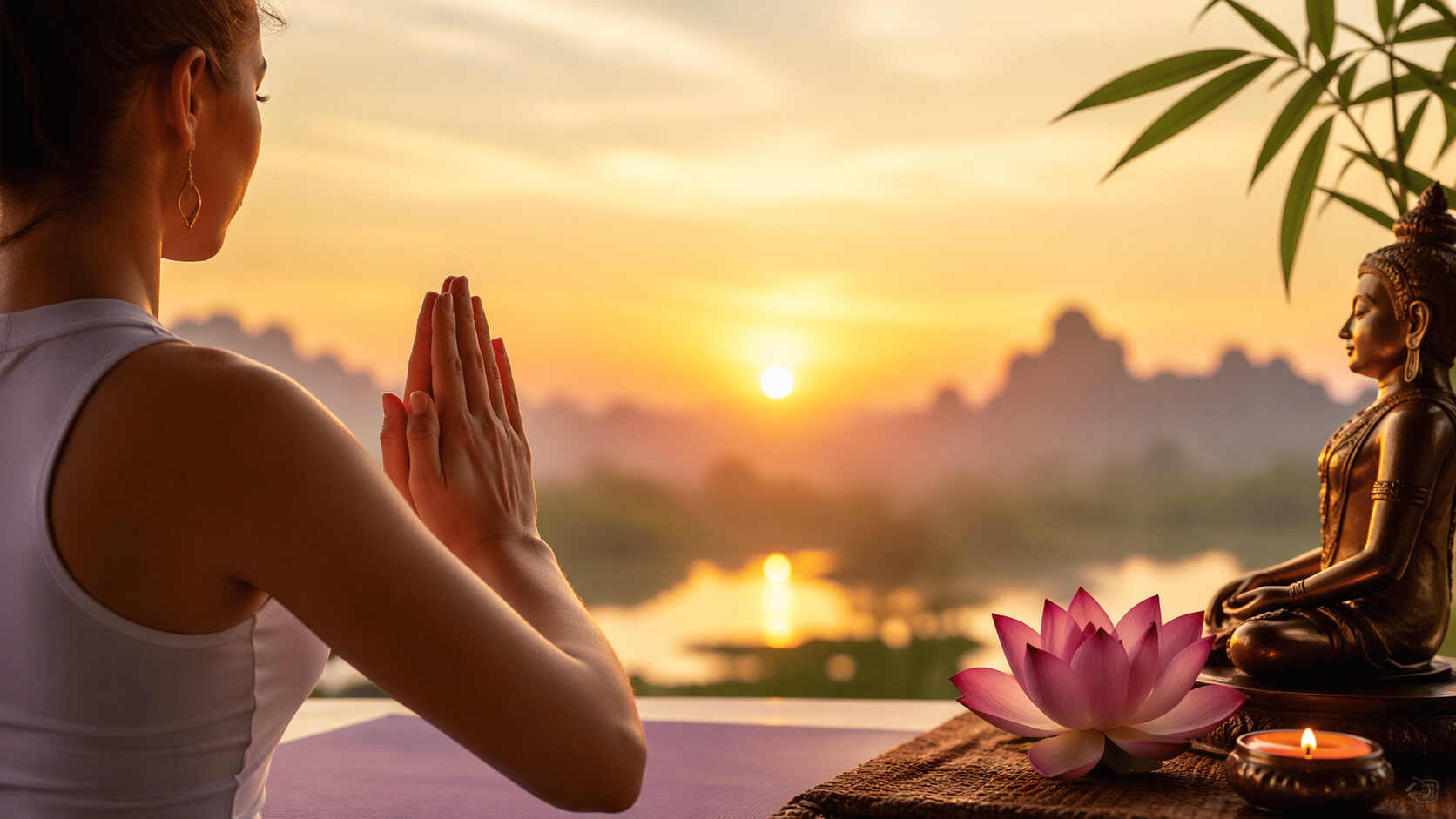
You have heard it a hundred times at the end of yoga class, and you have seen it printed on t-shirts and coffee mugs. The namaste meaning goes much deeper than most Western students realize. In Sanskrit, the word is really a complete sentence: a bow of respect offered from one person to another, usually with the palms pressed together at the heart.
Key Highlights
- Namaste literally translates from Sanskrit as “I bow to you,” from namas (bow, reverence) and te (to you).
- It is pronounced na-ma-stei (नमस्ते), not the common Western “nah-mah-stay.”
- The spoken word is usually paired with Anjali Mudra: palms pressed together at the heart center with a slight bow of the head.
- The spiritual reading used in yoga, “the divine in me bows to the divine in you,” honors the shared inner self, or atman.
- Use it with understanding, as a greeting, a thank-you, or the close of a class, and skip empty, decorative usage.
The Literal Translation: “I Bow to You”
Strip away the poetry and namaste is grammar. The word is built from two Sanskrit parts. Namaḥ means bow, obeisance, or adoration, and it traces back to the verbal root nam, “to bend or bow.” Te is the dative form of the second-person pronoun: “to you.” Put them together under Sanskrit sound rules (sandhi), and the final visarga of namaḥ softens before the t of te, producing namaste. Merriam-Webster traces the underlying verb to namati, meaning “she or he bends, bows” (Merriam-Webster).
This kind of compounding is typical of Sanskrit, the ancient liturgical language in which the foundational texts of Hinduism and yoga were written and which still serves as a learned language among scholars. Many yoga terms work the same way, from the famous seed syllable unpacked in our guide to the meaning of the Om symbol to longer declarations such as the Aham Brahmasmi mantra. Once you see the pattern, Sanskrit stops looking mystical and starts looking precise.
English borrowed the word surprisingly late. Its first appearances for a broad American readership came with coverage of newly independent India: TIME quoted Jawaharlal Nehru’s “traditional Hindu namasthe” greeting in August 1948 and again in October 1949. The spelling settled into namaste by the mid-20th century, and from there the word traveled with yoga into studios worldwide.
How to Pronounce Namaste
Say it na-ma-stei, with the stress on the final syllable and a long “a” sound, like “stay.” The Cambridge Dictionary gives the US pronunciation as /ˈnɑː.mə.steɪ/ (Cambridge Dictionary). The widespread Western “nah-mah-stay,” with a flat American “a” in the middle syllable, is the giveaway of a tourist pronunciation. Three syllables, stress at the end, and you are close to how it sounds in Hindi and Sanskrit alike.
The Gesture: Anjali Mudra
The word rarely travels alone. It is traditionally paired with Anjali Mudra, the pressed-palm gesture: bring both palms together with all ten fingers touching, rest the base of the thumbs lightly against the sternum, and bow the head slightly. The hands sit at the heart center, which yogic tradition regards as the seat of connection between people. The gesture has a simple symbolism teachers repeat for a reason. The left hand stands for the world of form and the right for the unseen, and joining them declares that the two are not separate.
Anjali Mudra belongs to no single religion. Hindus use it in temple worship, Buddhists and Jains use it in prayer and greeting, and Sikhs use it as a sign of respect. Across South and Southeast Asia it functions the way a handshake does in the West, except it keeps a respectful distance. That distance is exactly why the gesture found new life in 2020, when commentators called namaste “the perfect pandemic greeting” during COVID-19: full warmth, zero contact (Wikipedia).
The Spiritual Reading: “The Divine in Me Bows to the Divine in You”
In yoga the standard English rendering runs: “The divine light in me bows to the divine light in you.” The theology behind it is Hindu. Every person carries atman, the inner self or divine spark, and namaste acknowledges that spark in the other person while setting the speaker’s ego aside. It is a small act with a large claim: we are different people, and the same light sits in both of us.
This reading reached the West largely through American yoga teachers of the 1960s and 1970s, beginning with Ram Dass, and teachers like Shiva Rea and Deepak Chopra later repeated their own versions of it. “The spirit in me honors the spirit in you” is Chopra’s phrasing. Whether or not you subscribe to the metaphysics, the practical point survives translation: the person bowing does not claim superiority. When a teacher says namaste to a class, she declares herself an equal who honors the students, and the students answer in kind.
The same devotional logic runs through the sounds of a yoga class. Mantras chanted at the opening of practice, such as the Om Shanti mantra, carry the same intent of peace and recognition, and the broader tradition of mantra yoga treats sacred sound as a practice in its own right. Namaste is the shortest mantra most students will ever learn.
Namaste vs. Namaskar: What Is the Difference?
The two words are cousins, and the difference is mostly formality. Namaskar joins namas with kara, from the root kr (“to do, to make”), so it means something like “I make obeisance.” It reads as the more formal, weighty option: appropriate for elders, dignitaries, formal letters, and solemn occasions. Namaste is the warmer everyday form, the one used between friends, family, and yoga classmates.
In practice the two overlap constantly. An Indian shopkeeper, a yoga teacher in Ohio, and a monk in Kathmandu might each choose either word depending on the moment. If you remember only one rule, make it this: namaskar for formality, namaste for everything else, and neither is ever wrong when offered with sincerity.
Why Yoga Classes End With It
Most students meet namaste at the close of class, and the placement is deliberate. A session ends with the nervous system at its calmest, and the teacher uses that moment for three things: gratitude toward the students, acknowledgment that teacher and student practiced as equals, and a clear closing of the shared container. The students bow back, and the exchange seals the practice.
Some teachers open with it too, which sets a tone of mutual respect before a single pose. Either way, the ritual works the same way rituals always work: the repeated pairing of the gesture with a calm, attentive state trains the mind to associate the two. After enough classes, the word alone can recall the feeling. If you close your own home sessions this way, the setup helps: a stable, comfortable surface removes distraction so the closing bow lands, which is why choosing the right equipment matters, as our guide to how to choose a yoga mat explains.
Using It Respectfully: Common Mistakes
The fastest way to cheapen namaste is to treat it as decoration. Saying it as a joke, printing it on merchandise with no connection to its roots, or tossing it into conversation to sound spiritual all miss the point. The word carries a specific cultural and religious history, and using it well means knowing that history, at least in outline.
A few guidelines keep you on safe ground. Use it as a genuine greeting, a thank-you, or the close of a practice or meditation. Pair it with the hand gesture when you want the full expression, or say the word alone when a full bow would be awkward. Do not use it sarcastically, do not pair it with mockery of Indian accents or culture, and do not assume every Indian person wants a lecture on its etymology. Respect, in this case, mostly means restraint: let the word do its quiet work.
The 2020 moment is worth remembering. When handshakes became a health risk, leaders and neighbors worldwide adopted the pressed-palm greeting as a dignified substitute. That episode proved something the word’s history already suggested: namaste works because it was designed for exactly this, respectful acknowledgment of another person without presumption.
The Namaste Mindset in Daily Life
You do not need a yoga mat to use what the word teaches. The namaste mindset is a habit of pausing before you react: seeing the other person as a full inner life rather than an obstacle, a label, or a transaction. In traffic, in arguments, in customer service lines, the one-second pause that the gesture trains is the whole practice.
Three small applications carry most of the weight. Greet people as if their presence matters, because the word’s grammar says it does. Thank people specifically rather than on autopilot; namaste as a thank-you lands harder than a mumbled “thanks.” And end things cleanly: conversations, workdays, difficult discussions. A clear, respectful close beats a trailing-off every time. Practices that build inner strength and courage start from the same place, the willingness to meet a moment directly instead of flinching from it.
Conclusion
My recommendation: use the word only when you mean the bow behind it, and skip it when you do not. Your next step is simple. At the end of your next class or meditation, press your palms together, bow your head, and say it once, slowly, with the translation in mind.
Frequently Asked Questions
What does namaste literally mean?
Namaste literally means “I bow to you.” It combines the Sanskrit namas (bow, reverence, from the root nam, “to bend”) with te (“to you”), fused by Sanskrit sound rules. The spiritual rendering used in yoga, “the divine in me bows to the divine in you,” builds on this literal base.
How do you pronounce namaste correctly?
Pronounce it na-ma-stei, stressing the final syllable with a long “a” as in “stay.” The Cambridge Dictionary lists the US pronunciation as /ˈnɑː.mə.steɪ/. The common Western “nah-mah-stay” is a mispronunciation worth unlearning.
What is the difference between namaste and namaskar?
Namaskar is the more formal variant, roughly “I make obeisance,” suited to elders and solemn occasions. Namaste is the warmer everyday form used between friends, family, and yoga classmates. In practice they overlap, and either is correct when offered sincerely.
Why do yoga teachers say namaste at the end of class?
Teachers close class with namaste to express gratitude, to acknowledge students as equals rather than subordinates, and to give the shared practice a clear ending. Students bow the word back, which returns the gratitude and seals the session.
Is it disrespectful for non-Indians to say namaste?
No, it is not disrespectful when used with understanding and genuine respect. It becomes a problem when used as a joke, an empty trend, or a prop that ignores its cultural and religious roots. Appreciation with knowledge is welcome; decoration without it is not.
Do you have to press your hands together when saying namaste?
No. The word works on its own as a respectful greeting, and millions of daily uses in India involve no gesture at all. Adding Anjali Mudra, palms together at the heart with a slight bow, deepens the expression and is the traditional full form.