
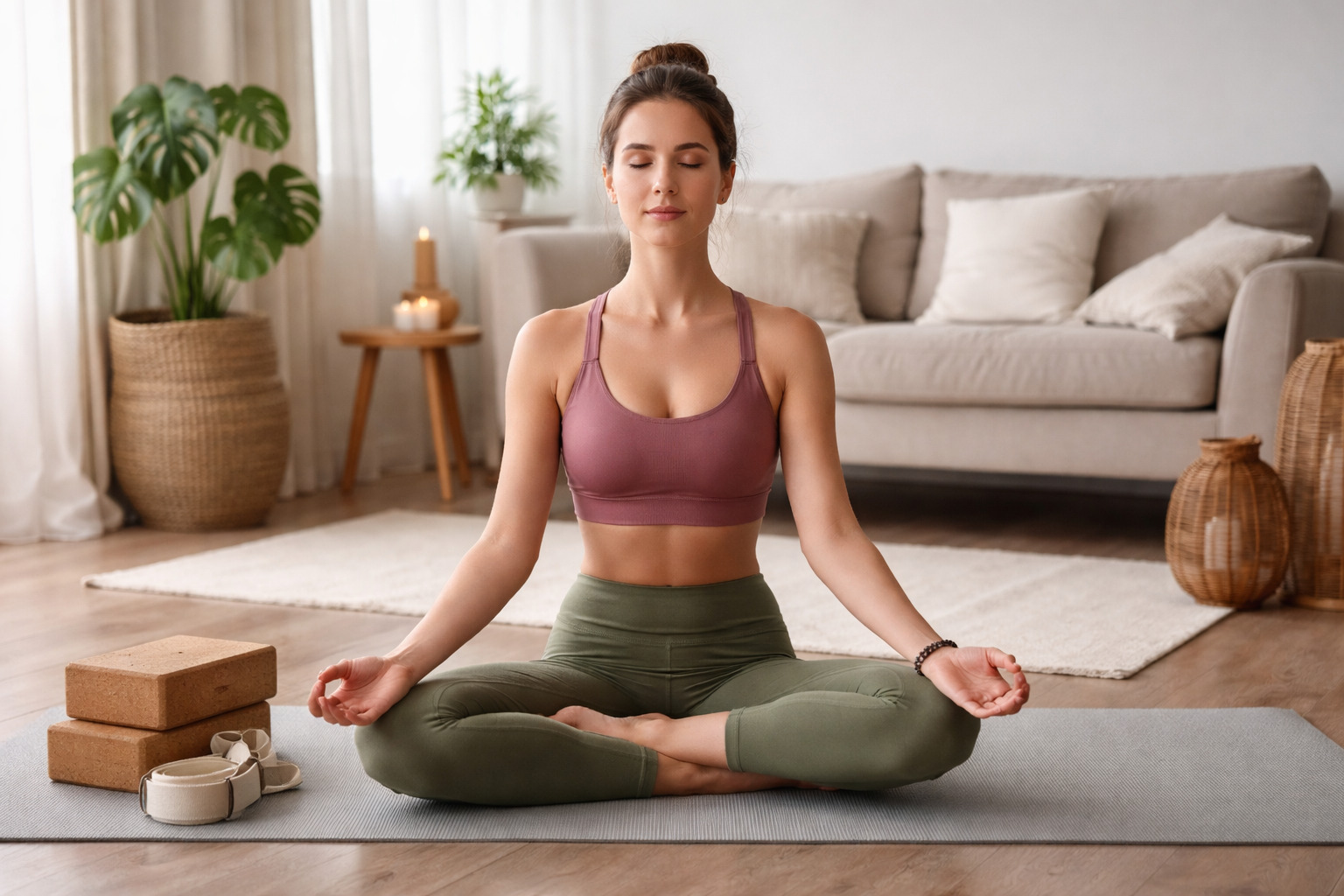
Home practice is the easiest way to keep yoga in your life, and it is also where bad habits form fastest. Without a teacher in the room, small errors repeat until they feel normal. The most common home yoga mistakes are simple to fix once you can name them.
Key Highlights
- Warm up for five minutes, and always close with Savasana.
- Breath is your gauge: if you cannot breathe smoothly, the pose is too much.
- Sharp or pinching pain is a stop sign, while a mild stretch is normal.
- A stable mat and a clear floor prevent most home accidents.
- Short, regular sessions build more skill than rare, intense ones.
Set Up a Safe Home Space First
Before you fix any single mistake, fix the room. Pick a flat spot with space to stretch your arms wide, move breakables out of reach, and clear the floor of clutter. A wall nearby gives balance support, and a quiet corner keeps interruptions away.
Your mat is the foundation of that space. A mat that slides turns every standing pose into a balance test you did not sign up for, so choose one with real grip and enough cushion for your knees, and keep it clean. If you are still deciding, this guide to choosing the right yoga mat covers thickness, material, and grip.
10 Home Yoga Mistakes Beginners Make
1. Skipping the Warm-Up
Cold muscles resist stretch. Jumping straight into deep folds or strong poses asks stiff tissue to do work it is not ready for, which is how strains happen. The NCCIH notes that most yoga injuries are sprains and strains, and a warm-up helps prevent them.
The fix: spend the first five minutes on gentle movement: cat-cow, neck rolls, and hip circles. If you wake up with sore muscles from yoga, take a longer warm-up and a gentler session. Cue: if your breath feels rushed, slow down.
2. Forcing Depth Instead of Building It
Flexibility is a result of practice, not a starting requirement. Many beginners push into a deeper fold because the shape in a photo looks like the goal. Forcing range strains ligaments and connective tissue, and the damage often shows up the next day.
The fix: work at about 70 percent of your maximum stretch. Bend your knees in forward folds, keep your spine long, and let range arrive over weeks. This is also the core of avoiding common vinyasa yoga injuries: the pose serves your body, not the other way around. Cue: if you cannot smile and breathe in the pose, back off.
3. Holding Your Breath
Breath-holding is the most common beginner habit, and it appears in the hardest poses, right when breathing matters most. When you hold your breath, your muscles tense and your mind narrows to the effort, turning the pose into a test of endurance instead of a practice of attention.
The fix: tie one breath to each movement: inhale to lengthen, exhale to fold or twist, breathing through the nose. If the breath turns ragged, the pose is too deep or held too long. Come out and re-enter smaller. Cue: count to four on each inhale and exhale in hard poses.
4. Ignoring Alignment
At home, no one adjusts your knee or reminds you to lengthen your spine. Small misalignments repeat hundreds of times across a month, and that turns a minor error into sore knees, a cranky lower back, or a stiff neck. Common examples are knees collapsing inward and shoulders creeping toward the ears in Downward Dog.
The fix: practice near a mirror or record yourself once a week. In every standing pose, check that knees track over ankles and the spine stays long, with shoulders away from the ears. If your neck carries tension after practice, read these yoga practices to relieve neck tension. Cue: in Downward Dog, press the floor away.
5. Practicing on the Wrong Surface
A thick rug, a slippery floor, or a worn-out mat changes every pose. Feet slide in standing balances, wrists take extra load in tabletop, and knees complain in lunges. Beginners often blame their balance when the surface is the real problem. A dirty mat is just as bad: dust and sweat kill grip.
The fix: practice on a firm, level floor with a clean, grippy mat. If you only have carpet, use the firmest area you can find and avoid deep balances there. Cue: test the surface with a slow Warrior II first.
6. Copying Videos Pose for Pose
Online classes are a gift for home practice, and they are also a trap. A video teacher cannot see your body, so their cues fit an average student who does not exist. Copying the shape on screen ignores your bone structure, your injury history, and your strength. Advanced poses in short clips are the worst offenders.
The fix: use videos as guidance, not as a shape to match. Pick classes labeled beginner or gentle, follow the verbal cues, and modify freely. Skip any pose that needs a skill you have not built yet. The NCCIH advises beginners to avoid extreme practices such as headstands and forceful breathing until they have solid guidance. Cue: if you watch the screen more than you feel your body, pause the video and practice by feel.
7. Rushing Through Poses
Speed hides mistakes. When you move fast, you skip the small adjustments that protect your joints, and you never learn what a pose actually feels like. Rushing also shortens holds, so muscles never get the sustained load that builds strength.
The fix: slow down on purpose. Hold standing poses for five to eight breaths, with one full breath in each transition. Moving slowly lets you notice a drifting knee or a lifting shoulder. For timing, see this expert guide to how long to hold a yoga pose. Cue: if you finish a pose and cannot remember how it felt, you moved too fast.
8. Skipping Savasana
Savasana looks like doing nothing, so beginners treat it as optional. It is where your nervous system shifts out of effort and your body absorbs the work you just did. Skipping it leaves you wired and tense.
The fix: protect five to ten minutes at the end of every practice for Savasana. Lie flat, rest your arms away from your body, and let your breath return to normal. If time is short, shorten the active poses, not the rest. Cue: set a soft timer so you can actually rest.
9. Practicing on a Full Stomach or While Injured
Yoga compresses and twists the abdomen, so a full stomach turns forward folds and twists into discomfort or nausea. Practicing through an injury is a different risk: pain changes how you move, and the body compensates by loading other joints.
The fix: wait two to three hours after a full meal, or eat a light snack 30 to 45 minutes before. With an injury, modify or skip the poses that load it and choose a gentle session instead. Sharp, pinching, or shooting pain means stop, not push through. The Cleveland Clinic advises beginners to start gently and treat pain as a signal to modify or stop. Cue: before you unroll the mat, ask whether your body needs movement today or rest.
10. Practicing Inconsistently, Then Overdoing It
Two long sessions a month will not build the strength or habit that three short sessions a week will. Inconsistent practice also sets up the overdoing trap: after a gap, people try to make up for lost time with a long, intense session, and that is when strains appear.
The fix: commit to a small, fixed schedule you can actually keep, such as 20 minutes on three set days each week. Add time only after a month of steady practice. If you miss a week, return at the same level you left, not a harder one. When your practice has gone stale, this guide to rebooting your yoga practice refreshes your routine without starting over. Cue: put practice on the calendar and protect it.
How to Build a Home Routine That Lasts
A routine that lasts is built from small pieces. Start with a fixed time of day, a short session, and one or two poses you enjoy, then add variety as the habit sticks. Keep a simple log; after a few weeks it shows which poses help and which strain you.
Progress in home yoga is quiet: steadier balance, easier breathing in a hard pose, and less soreness the next morning. Measure it that way, not by how deep a pose looks. The NCCIH notes that yoga may help with stress, sleep, and balance, and those gains come from regular practice, not single heroic sessions. Mount Sinai’s Icahn School of Medicine adds the practical rules: warm up, move smoothly without bouncing, listen for red-flag pain, and rest in Child’s Pose whenever you need it.
When to Seek a Teacher
Home practice works best when a teacher checks it now and then. Book a class or a private session if you have a persistent ache, a new injury, a medical condition such as high blood pressure or glaucoma, or are pregnant. A teacher can see the alignment error you cannot feel and give you a modification that fits your body. The NCCIH states that learning yoga on your own without supervision has been associated with increased risks, so an occasional in-person check is a safety measure.
Frequently Asked Questions
What is the biggest mistake beginners make in home yoga?
Skipping the warm-up is the biggest mistake, because cold muscles and joints are far easier to strain. Five minutes of gentle movement raises blood flow and prepares the body for deeper poses. Pair that with steady breathing and you remove the two most common causes of beginner injury in one step.
How long should a beginner practice yoga at home?
Start with 15 to 20 minutes, three times a week. Short sessions done regularly build strength, flexibility, and habit faster than occasional long ones. Add five minutes at a time once the routine feels easy, and keep at least one rest day between harder sessions.
Is it safe to learn yoga at home without a teacher?
It can be safe if you keep the practice gentle, avoid advanced poses, and listen to pain signals. The NCCIH notes that learning yoga without supervision carries higher risk than learning with a qualified instructor. Check in with a teacher now and then, especially if you have an injury or a medical condition.
Should I practice yoga every day?
Daily practice is fine once your body is used to it, but beginners do better with three or four sessions a week and rest days in between. Rest days let sore muscles recover and keep motivation up. If you practice daily, keep some sessions gentle or restorative rather than intense.
What should I do if a yoga pose hurts?
Stop the pose and come out slowly. Mild stretch discomfort is normal, but sharp, pinching, or shooting pain is a warning to stop. Modify the pose with props, try a gentler version, or skip it for the day. Pain that lingers or limits daily movement deserves advice from a health professional.
Can I do yoga on a full stomach?
No, wait two to three hours after a full meal before practicing. Twists and forward folds compress the abdomen, so a full stomach causes discomfort or nausea. A small snack 30 to 45 minutes before practice is fine if you need energy.
Fix one mistake at a time, starting with the warm-up. Roll out your mat tomorrow, keep the session short, and notice how your breath and body respond.