
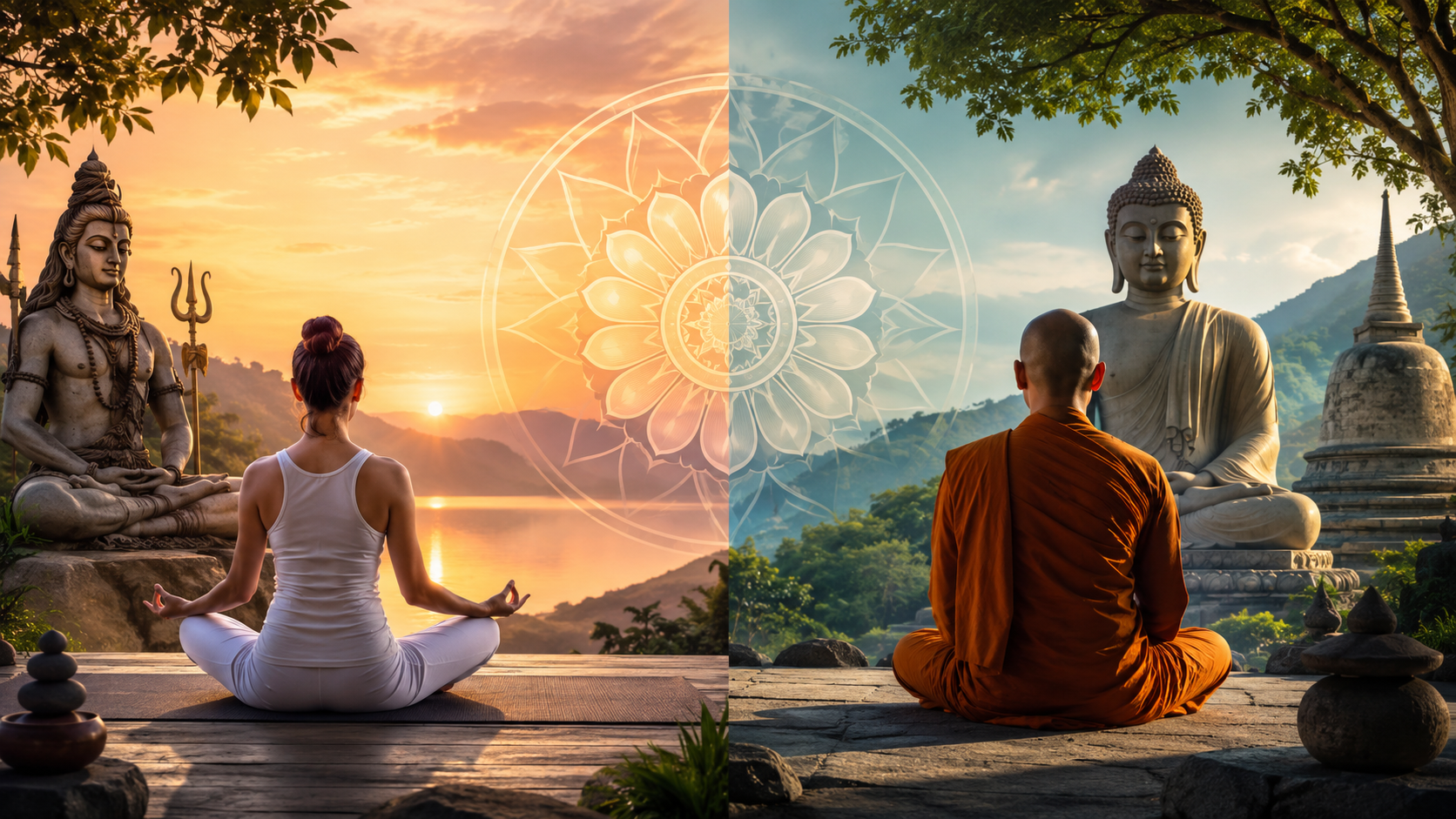
Introduction
Yoga and Buddhism are two of the world’s oldest spiritual traditions, both originating in ancient India and deeply influencing global approaches to mindfulness, meditation, self-awareness, and inner peace. Because they share common roots and overlapping concepts, many people often assume that yoga and Buddhism are essentially the same. In modern culture, especially in the West, yoga studios frequently incorporate meditation and mindfulness practices associated with Buddhism, while Buddhist teachings often include techniques similar to yogic meditation.
Despite these similarities, yoga and Buddhism are fundamentally distinct traditions with different philosophies, goals, beliefs, and methods of spiritual practice. Their understanding of the self, consciousness, liberation, and the nature of reality differs significantly. Yoga emerged primarily from Hindu philosophical systems, while Buddhism developed as a separate spiritual path founded by Siddhartha Gautama, the Buddha.
Today, yoga is often associated with physical postures and wellness routines, whereas Buddhism is commonly viewed as a philosophy of mindfulness and meditation. However, both traditions are much deeper than these modern interpretations. To truly understand their relationship, it is important to explore their origins, beliefs, spiritual objectives, ethical teachings, and meditative practices in detail.
This guide explains the similarities and differences between yoga and Buddhism in a clear and comprehensive way, helping readers understand how these two traditions intersect and where they diverge.
The Origins of Yoga
Yoga originated in ancient India thousands of years ago and developed within the broader framework of Hindu philosophy. The word “yoga” comes from the Sanskrit root “yuj,” meaning “to unite” or “to join.” Traditionally, yoga refers to the union of individual consciousness with universal consciousness.
Ancient yogic teachings can be found in sacred Indian texts such as:
- The Vedas
- The Upanishads
- The Bhagavad Gita
- Patanjali’s Yoga Sutras
Classical yoga was not originally focused on physical exercise. Instead, it emphasized spiritual discipline, meditation, ethical living, and self-realization. Modern postural yoga, commonly practiced in studios today, represents only one aspect of the broader yogic tradition.
Patanjali’s Yoga Sutras outlined the famous Eight Limbs of Yoga, which include ethical principles, meditation, concentration, and spiritual absorption. These teachings aimed to quiet the fluctuations of the mind and help practitioners realize their true nature.
Yoga evolved into multiple branches over time, including:
- Bhakti Yoga (path of devotion)
- Karma Yoga (path of action)
- Jnana Yoga (path of knowledge)
- Raja Yoga (path of meditation)
- Hatha Yoga (physical and energetic discipline)
Each path approaches spiritual growth differently, but all seek liberation from suffering and ignorance.
The Origins of Buddhism
Buddhism began more than 2,500 years ago with Siddhartha Gautama, who later became known as the Buddha, meaning “the awakened one.” After witnessing suffering in human life, Siddhartha renounced his royal lifestyle and dedicated himself to spiritual inquiry.
Following years of meditation and ascetic practices, he attained enlightenment under the Bodhi tree and began teaching the principles that became Buddhism.
The Buddha’s teachings centered on understanding suffering and finding liberation from it. His core teachings include:
- The Four Noble Truths
- The Noble Eightfold Path
- Impermanence
- Mindfulness
- Compassion
- Non-attachment
Unlike yoga’s roots in Hindu metaphysics, Buddhism developed as an independent spiritual system that questioned certain Vedic beliefs and rituals.
Buddhism spread across Asia and evolved into several major traditions:
- Theravada Buddhism
- Mahayana Buddhism
- Vajrayana Buddhism
Each tradition developed unique practices and interpretations while retaining the Buddha’s essential teachings.
Shared Historical Background
Yoga and Buddhism emerged from the same cultural and spiritual environment of ancient India. As a result, they share many terms, concepts, and practices.
Both traditions developed during a period of intense philosophical inquiry in India, where seekers explored questions related to suffering, consciousness, rebirth, karma, and liberation.
Because of these shared origins, yoga and Buddhism have influenced one another throughout history. Many scholars describe them as sister traditions.
Both systems:
- Emphasize meditation
- Value ethical conduct
- Seek liberation from suffering
- Recognize karma and rebirth
- Encourage self-discipline
- Promote compassion and non-violence
However, beneath these similarities lie important philosophical differences.
The Central Goal of Yoga
The primary goal of yoga is self-realization and union with higher consciousness.
Classical yoga teaches that beneath the ego and temporary identity exists the true Self, often referred to as Atman or Purusha. This inner consciousness is eternal and divine.
The yogic path aims to remove ignorance and realize this true Self through:
- Meditation
- Ethical living
- Breath control
- Spiritual discipline
- Devotion
In many yogic traditions, liberation means recognizing the unity between individual consciousness and universal reality, often called Brahman.
This realization is considered the highest spiritual state.
The Central Goal of Buddhism
Buddhism focuses on liberation from suffering through awakening and insight.
The Buddha taught that suffering arises from attachment, craving, and ignorance. Liberation, or Nirvana, is achieved by understanding the true nature of reality and freeing oneself from attachment and delusion.
Unlike yoga, Buddhism does not emphasize union with a divine self. Instead, it teaches awareness, wisdom, and direct understanding of impermanence and non-self.
The Buddhist path aims to:
- End suffering
- Cultivate mindfulness
- Develop compassion
- Let go of ego-based attachment
- Achieve enlightenment
Although both traditions seek liberation, their understanding of liberation differs fundamentally.
The Concept of the Self
One of the biggest differences between yoga and Buddhism concerns the idea of the self.
Yoga’s View of the Self
Yoga generally teaches that there is a true eternal Self known as Atman. This Self is pure consciousness beyond the body, mind, and ego.
According to yogic philosophy:
- The ego is temporary
- The body is temporary
- Thoughts and emotions are temporary
- The true Self is eternal
The spiritual journey involves realizing this deeper identity.
Buddhism’s View of the Self
Buddhism rejects the idea of a permanent self or soul. This teaching is known as “Anatta” or “Anatman,” meaning non-self.
According to Buddhism:
- What we call the self is constantly changing
- Identity is a collection of temporary experiences
- Attachment to a fixed self creates suffering
The Buddha taught that recognizing the absence of a permanent self leads to freedom from attachment and suffering.
This philosophical difference is one of the clearest distinctions between yoga and Buddhism.
Beliefs About God and Divinity
Yoga and God
Many yogic traditions recognize God, divine consciousness, or a cosmic creator.
- Patanjali’s Yoga Sutras include the principle of Ishvara-Pranidhana, meaning surrender to God or the divine. Bhakti Yoga focuses entirely on devotion to God.
- Different schools of yoga interpret divinity differently, but many accept the existence of higher spiritual reality.
Buddhism and God
Buddhism generally does not focus on a creator God.
- The Buddha emphasized direct experience and inner awakening rather than devotion to a supreme creator.
- While some Buddhist traditions include celestial beings and Bodhisattvas, these are not viewed as creators of the universe.
Buddhism focuses more on understanding the mind and overcoming suffering through wisdom and practice.
Meditation in Yoga and Buddhism
Meditation is central to both traditions, though the methods and goals may differ.
Meditation in Yoga
Yogic meditation often aims to:
- Quiet the mind
- Concentrate awareness
- Connect with higher consciousness
- Experience spiritual union
Meditation is one part of a larger yogic system involving ethical living, breathwork, and physical discipline.
Meditation in Buddhism
Buddhist meditation emphasizes:
- Mindfulness
- Insight into reality
- Awareness of impermanence
- Observation without attachment
Common Buddhist meditation practices include:
- Vipassana (insight meditation)
- Samatha (calming meditation)
- Loving-kindness meditation
Buddhist meditation often focuses more directly on observing thoughts and sensations without identifying with them.
Physical Practices and the Body
Yoga’s Physical Dimension
Modern yoga is widely associated with physical postures known as asanas.
Originally, these postures were designed to prepare the body for meditation by improving:
- Flexibility
- Strength
- Balance
- Energy flow
Today, many people practice yoga mainly for physical health, stress relief, and fitness. However, traditional yoga viewed physical postures as only one small part of spiritual practice.
Buddhism’s Physical Practices
Buddhism generally places less emphasis on physical postures and bodily exercises.
- While certain Buddhist traditions include movement practices and breathing techniques, the primary focus remains mental cultivation and meditation.
- The body is viewed as important, but mainly as a vehicle for mindfulness and awareness rather than spiritual union.
Ethics and Moral Teachings
Both yoga and Buddhism emphasize ethical living.
Ethical Principles in Yoga
Yoga includes moral disciplines known as:
- Yamas
- Niyamas
These principles encourage:
- Non-violence
- Truthfulness
- Non-stealing
- Self-discipline
- Purity
Ethical living is considered essential for spiritual growth.
Ethical Principles in Buddhism
Buddhism teaches ethical conduct through:
- The Five Precepts
- Compassion
- Right action
- Right speech
- Right livelihood
The Buddhist path emphasizes reducing harm and cultivating compassion for all living beings.
Both traditions strongly value non-violence and mindfulness in daily life.
Karma and Rebirth
Yoga and Buddhism both accept the ideas of karma and rebirth, though they interpret them differently.
Yoga’s Understanding of Karma
In yoga, karma refers to actions and their consequences across lifetimes. Liberation frees the soul from the cycle of rebirth.
Buddhism’s Understanding of Karma
Buddhism also teaches karma and rebirth, but without an eternal soul migrating between lives.
Instead, rebirth is understood as a continuation of causes and conditions rather than the movement of a permanent self.
Modern Interpretations in the West
In modern Western culture, yoga is often reduced to:
- Exercise
- Stretching
- Wellness routines
- Fitness classes
Meanwhile, Buddhism is often presented as:
- Mindfulness
- Meditation
- Stress reduction
- Mental wellness
These simplified interpretations can obscure the deeper philosophical foundations of both traditions.
Many practitioners today combine elements of yoga and Buddhism without strictly following either tradition.
Can Yoga and Buddhism Be Practiced Together?
Many people integrate yogic and Buddhist practices into their daily lives.
Because both traditions value meditation, compassion, mindfulness, and inner awareness, they can complement one another practically.
For example:
- Yoga postures may support meditation
- Buddhist mindfulness may deepen yoga practice
- Breathwork may enhance concentration
- Ethical teachings may overlap naturally
However, at a philosophical level, important differences remain regarding self, divinity, and liberation.
Which Path Is Right for You?
Choosing between yoga and Buddhism depends on personal beliefs, goals, and interests.
Yoga may appeal more to individuals interested in:
- Spiritual union
- Divine consciousness
- Physical practice
- Holistic wellness
- Traditional Hindu philosophy
Buddhism may resonate more with those interested in:
- Mindfulness
- Non-attachment
- Insight meditation
- Psychological awareness
- Non-theistic spirituality
Many people appreciate wisdom from both traditions without identifying exclusively with either.
Conclusion
Yoga and Buddhism are deeply connected yet fundamentally distinct spiritual traditions. Both emerged from ancient India and share values such as meditation, compassion, mindfulness, ethical living, and liberation from suffering. Their historical relationship and overlapping practices often make them appear similar, especially in modern global culture.
However, important philosophical differences separate the two systems. Yoga generally teaches the existence of an eternal Self and often recognizes divine consciousness, while Buddhism rejects the idea of a permanent self and focuses on awakening through insight into impermanence and non-attachment.
Understanding these similarities and differences allows practitioners to appreciate both traditions more deeply. Whether someone chooses yoga, Buddhism, or a combination of practices from both, each path offers valuable tools for inner awareness, personal growth, and spiritual exploration.