
In the modern world, spending countless hours hunched over keyboards and screens has made poor posture an epidemic. This misalignment doesn’t just affect your appearance; it impacts your breathing, energy levels, and long-term spinal health.
Fortunately, the ancient practice of yoga offers a powerful, holistic solution. This guide will show you how to leverage targeted poses for genuine posture correction yoga, helping you sustainably improve posture with yoga and reclaim a confident, healthy stance.
The Anatomy of Posture: Where Alignment is Lost
Poor posture is rarely a matter of simply “sitting up straight.” It’s an imbalance: muscles in the front of the body become tight and short (e.g., chest, hip flexors), while the opposing muscles in the back become weak and stretched (e.g., upper back, core).
Yoga’s genius lies in simultaneously strengthening the neglected postural muscles and stretching the over-tightened muscles, teaching your body’s structure to reset to its optimal, natural alignment.
Key Postural Issues Corrected by Yoga:
- Kyphosis (Slouching): Addressed by opening the chest and strengthening the upper back.
- Anterior Pelvic Tilt: Corrected by stretching tight hip flexors and engaging the core and glutes.
- Forward Head Posture (FHP): Reverses the “tech neck” slump by strengthening the deep neck flexors.
Essential Yoga Poses for Back Strength and Correction
The foundation of perfect posture is a strong, stable core and a resilient upper back. These poses specifically target the key stabilizing muscles required for long-term yoga to achieve perfect posture.
1. Mountain Pose (Tadasana): The Blueprint for Alignment
This is the most crucial pose. It’s not about standing still; it’s about actively engaging your entire structure. Stand tall, lift your toes, spread them, and place them back down. Slightly tuck your tailbone to neutralize the pelvis. Draw your shoulder blades down your back and slightly toward each other. Imagine a string pulling the crown of your head toward the ceiling.
Benefit: Teaches you what true vertical alignment feels like and establishes core engagement.
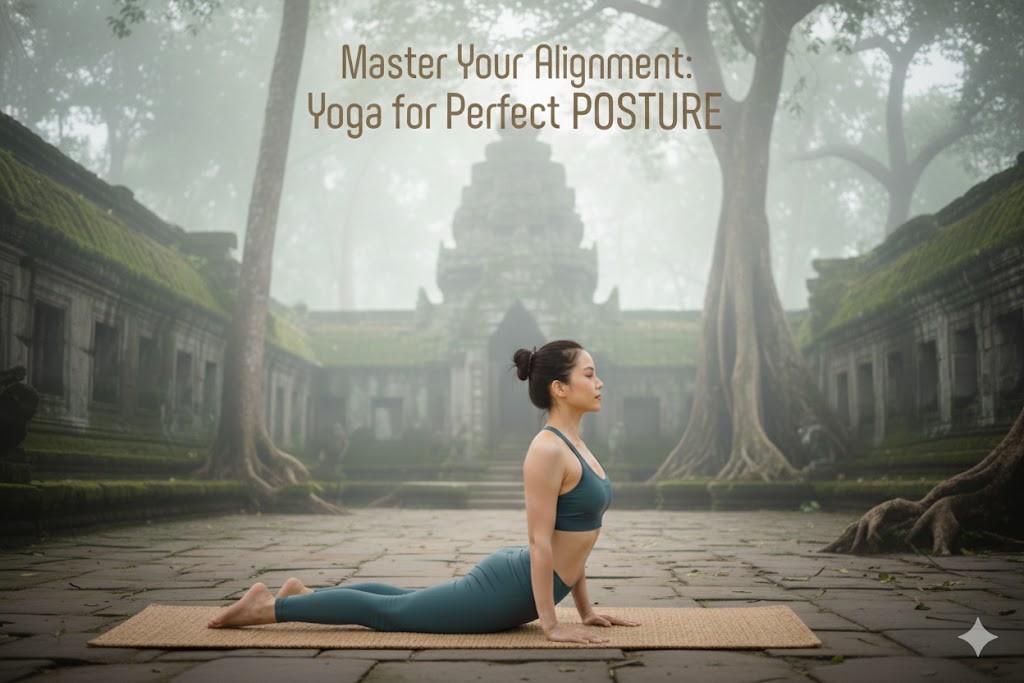
2. Cobra Pose (Bhujangasana): Building Upper Back Strength
Cobra is excellent for strengthening the muscles that retract the shoulder blades, directly combating the slouch. Lie on your belly, hands under your shoulders. Press your pubic bone into the floor. Inhale, lift your chest only using your back muscles, keeping a micro-bend in the elbows and reaching the chest forward.
Benefit: Strengthens the extensors of the spine and the rhomboids, which are vital for fighting Kyphosis.
3. Locust Pose (Salabhasana): Targeting Forward Head Posture
A powerful pose for strengthening the entire posterior chain, including the often-neglected muscles that support the head and neck. From the belly, interlace your fingers behind your back. Inhale and lift the head, chest, arms, and legs simultaneously, gazing at the floor to keep the neck neutral.
Benefit: Directly targets the muscles needed to counteract forward head posture.
Releasing Tension: Stretches for Optimal Alignment
While strengthening the back, you must open the front of the body to allow the shoulders to naturally draw back and down.
4. Fish Pose (Matsyasana): The Gentle Chest and Neck Opener
An invaluable pose for reversing the constant rounding of the shoulders and relieving tension caused by poor alignment. Lie on your back, slide your hands (palms down) underneath your buttocks. Pressing into your forearms, lift your chest, arching your upper back, and let the crown of your head rest lightly on the floor.
Benefit: Powerfully stretches the chest and anterior neck muscles, correcting the tight-front/weak-back imbalance.
Quick Fixes: Desk Yoga for Perfect Posture
The greatest gap in most posture advice is integration into daily life. This simple routine can be performed right at your workstation to combat “tech neck” and poor alignment, providing desk yoga for improved posture.
- Seated Cat-Cow (1 minute): While seated, inhale, arch your back, and lift your chest forward (Cow). Exhale, round your back, and tuck your chin (Cat). This mobilizes the spine and releases lower back stiffness.
- Seated Figure-Four Stretch (1 minute per side): Cross one ankle over the opposite knee. Lean forward slightly. This stretches the hips and glutes, combating tightness from sitting that contributes to pelvic tilt.
- Shoulder Blade Squeeze (30 seconds): Sit tall. Without moving your arms, squeeze your shoulder blades toward each other for a count of five, then release. Repeat five times. This is a micro-strength exercise for yoga poses for back strength.
- Gentle Neck Release (1 minute): Drop your right ear toward your right shoulder for 30 seconds, then repeat on the left. This relieves tension contributing to a slumping forward head posture.
Conclusion: Consistency is Your Best Posture Correction Tool
Achieving and maintaining perfect posture is not a one-time fix; it’s a daily commitment to balance. By integrating posture correction yoga into your routine—even a short session of 10-15 minutes—you can build the necessary strength, increase mobility, and teach your body to hold itself in a state of confident, optimal health. Start today and feel the difference a mindful, aligned spine can make.